

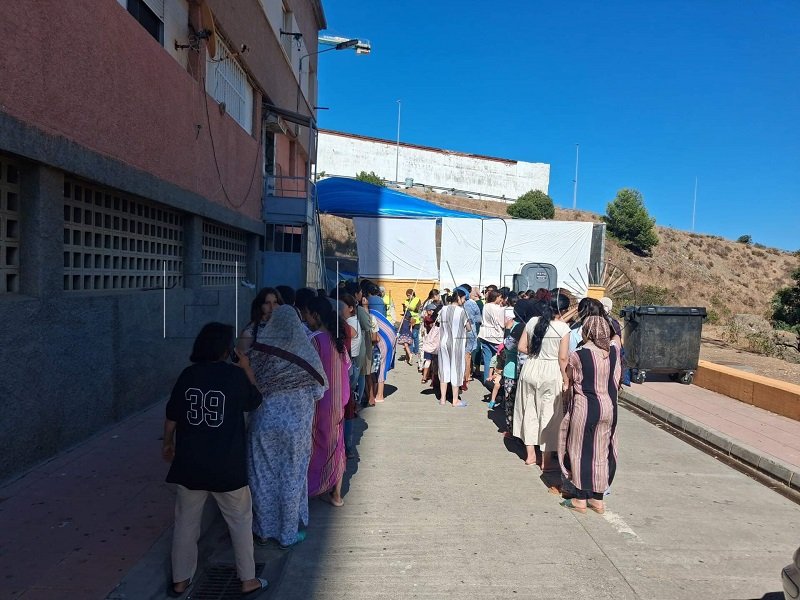
The crisis in Ceuta can no longer be measured only by the number of people who entered the city at the end of July, or by those who were subsequently returned or left the territory. A month later, its consequences are appearing elsewhere: in protection services, in the courts, in complaints filed by women and minors, and in institutions forced to adapt to an exceptional situation.
The latest figures released by Spain’s Public Prosecutor’s Office reveal a particularly sensitive dimension of this new phase: 23 sexual assaults were recorded in Ceuta between July 30 and August 31, including five cases classified as rape. Nine of the victims were minors between the ages of 14 and 17.
But the number, however disturbing, is not enough to explain what happened.
According to the available information, many of the victims were migrant women and girls who had arrived in the city during the mass influx. Spanish media have also reported a case involving a member of the LGBT community and incidents in which more than one alleged perpetrator was involved.
The essential point lies elsewhere.
The Public Prosecutor’s Office has not presented these cases as evidence that migration itself produced sexual violence. Rather, they form part of an increase in certain categories of crime recorded during an exceptional period.
Spain’s Prosecutor General, Teresa Peramato, had already referred during her visit to Ceuta to an increase in sexual assaults, alongside property crimes, assaults and resistance to law enforcement.
That is where the real story begins.
From a Judicial Figure to a Question of Protection
The nine minors are not simply another number in a crime statistic. They are between 14 and 17 years old. They were already in a vulnerable situation: sudden displacement, instability, separation from family or the absence of family networks, followed by accommodation in temporary spaces that were not designed to absorb an influx on this scale.
Almost a month after the mass arrivals, Ceuta’s authorities were still working to bring hundreds of girls into the child-protection system, while preparing additional spaces for women and girls.
That exposes a deeper reality: the risk does not begin with sexual assault. It begins when protection becomes inadequate.
For a woman or minor arriving in a city under exceptional circumstances, the danger is not limited to the assault itself. It may begin with having nowhere safe to sleep, uncertainty about legal status, or difficulty accessing healthcare, psychological support or legal assistance.
This is why the crisis has tested more than the police and the prosecution service.
It has also exposed the limits of a protection system confronted, within days, with an extraordinary level of pressure.
Eight Identified Suspects Do Not Mean 23 Identified Perpetrators
On the judicial side, security forces have so far identified eight suspects: four Moroccans, three Spaniards and one Belgian.
That figure needs to be read carefully.
It does not mean that four Moroccans were responsible for four assaults, nor does it mean that the remaining assaults were necessarily committed by migrants. Twenty-three incidents have been recorded, while only eight suspected perpetrators have been identified so far. Investigations into the remaining cases are continuing.
The distinction between a judicial fact and a political interpretation is therefore not a minor detail.
An assault must be investigated and prosecuted as a crime, regardless of the perpetrator’s nationality. But turning the nationality of some suspects into a general explanation for the phenomenon requires evidence that the current figures do not provide.
At the same time, concern over the political exploitation of these cases must not lead to their seriousness being minimized or to the victims being pushed into the background.
The Crisis Has Moved Beyond the Border
Since July 30, Madrid has largely approached the situation as a migration and security crisis: border control, management of arrivals, identification, returns and the reinforcement of security measures.
But the following weeks forced a broader definition of the crisis.
The question was no longer simply how to prevent irregular entry.
It was also about where to accommodate those already there, how to protect minors, how to guarantee women a safe environment, and how police, prosecutors and courts could process the new cases without victims’ rights being overwhelmed by administrative urgency.
The justice system itself began showing signs of pressure. Spain’s General Council of the Judiciary called for additional judicial resources in Ceuta, particularly in areas involving violence against women and sexual assaults.
The crisis had therefore changed territory.
It was no longer visible only on beaches and around border barriers. It was now appearing in police stations, reception centres, social services, medical facilities and courtrooms.
La Fiscalía registra 23 agresiones sexuales en Ceuta durante la crisis migratoria
What the Numbers Still Do Not Tell Us
The figure of 23 is not necessarily final.
Only days earlier, the Prosecutor General had referred to 16 sexual assaults and 17 victims. The figure subsequently rose to 23 assaults, including five rapes, with nine minors among the victims.
That change does not necessarily mean that all of the additional assaults occurred during those few days. It may also reflect new complaints, the identification of additional incidents and the progress of investigations.
We are therefore dealing with ongoing investigations, not 23 final criminal convictions.
But one fact is already clear enough: for the women and girls who arrived in Ceuta during the July influx, the crisis did not end when they crossed the border.
A second phase began.
The first was highly visible: thousands of people on the beaches, security forces, barriers, the sea and images broadcast continuously.
The second is much quieter. A girl looking for a safe place to sleep. A victim who needs medical care, to be heard and to receive legal support. A case that needs to be investigated. An institution expected to protect people it was not prepared to receive in such numbers.
That may be the real significance of the figure released by the Public Prosecutor’s Office.
The 23 sexual assaults do not, by themselves, explain the Ceuta crisis. They do, however, show that the crisis did not end when the border became quieter. It moved into the city itself, where the state’s ability to protect, care for and deliver justice has become the real test of what comes after July 30.
The next figures will matter. Not only to establish how many assaults are ultimately confirmed, but to determine whether institutions succeeded in closing the gaps that emerged during the first weeks.
It is there, far from the border and in spaces much less visible, that the real cost of the July 30 crisis will now be measured.


