

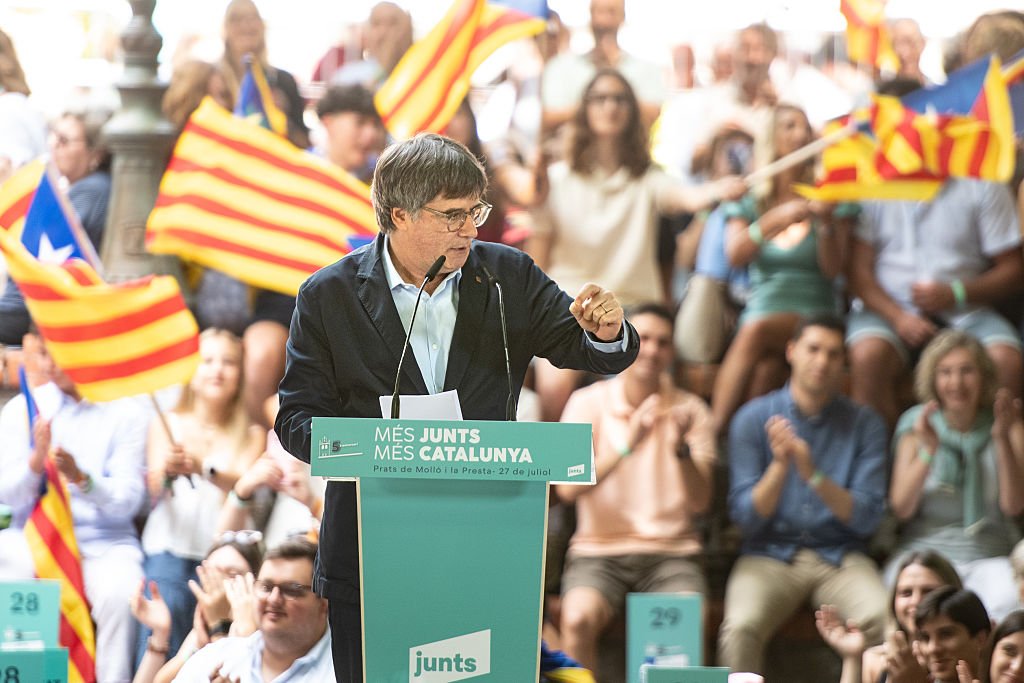
The Ceuta and Melilla issue did not need a new Moroccan statement to return to the centre of Spain’s political debate from an unusual angle. This time, the words came from Carles Puigdemont, former president of the Catalan government and leader of Junts, who, in an interview with The Times, described Ceuta and Melilla as “colonies or cities inside Morocco”. He also said that, from the Moroccan perspective, they represented a “wound”, before moving beyond a historical or geographical description: in his view, the inhabitants of the two cities should be given the opportunity to express their position on their political future and sovereignty through a self-determination referendum.
Puigdemont did not deny in the interview that the people of Ceuta are “very Spanish”. But he placed that reality within a different logic: in his view, the legitimacy of that belonging would be more firmly established if it were tested at the ballot box. The idea does not come from a politician with no connection to the issue. It comes from a man whose political career has been shaped in significant part by the principle that self-determination and referendums can serve as instruments for resolving questions of sovereignty.
That gives his current statement a significance beyond the personal position of a former regional president.
On 19 May 2021, at the height of the Moroccan-Spanish crisis surrounding Ceuta, Puigdemont had already written in French that Ceuta and Melilla were “two African cities” whose presence within the European Union was linked to the legacy of Europe’s colonial past. He explicitly defended Morocco’s right to raise the question of sovereignty and called for direct dialogue between Rabat and Madrid to address the dispute.
At the time, his remarks could be viewed as the position of a Catalan independence leader using a crisis between two states to reinforce his own political understanding of the Spanish state. Today, the context has shifted somewhat.
On 3 September, Puigdemont publicly recommended an article by academic Joseph Massad discussing Ceuta and Melilla through the lens of colonialism and decolonisation, linking the status of the two cities to the question of ending the colonial process. Days later, on 9 September, the discussion moved from articles and social-media posts into Spain’s institutional sphere. Junts called on the government to address Morocco’s sovereignty claims “democratically” and argued that the political future of the two cities should be determined by the freely expressed will of their inhabitants through a referendum. Senator Eduard Pujol defended the proposal in the Senate.
The chronology matters more here than the statement itself.
What was, years ago, a position expressed by Puigdemont outside Spain’s institutions became, in September 2026, a political proposal carried by his party into one of the country’s constitutional institutions. The debate is therefore no longer limited to whether Morocco is making a sovereignty claim or whether Madrid rejects it. A Spanish party with parliamentary representation is now calling for the will of the inhabitants of Ceuta and Melilla to be included in the equation determining their future.
And this is happening while the Spanish government is moving in an entirely different direction.
On 3 September, Prime Minister Pedro Sánchez told the Congress of Deputies that his government would “never abandon” Spanish sovereignty over Ceuta and Melilla. Earlier, on 11 August, Foreign Minister José Manuel Albares had reaffirmed the government’s commitment to Spain’s sovereignty and territorial integrity during his visit to Ceuta. In September, Madrid did more than repeat that position: it also pursued measures at the European level aimed at strengthening the two cities’ place within the institutions and mechanisms of the European Union, including efforts to expand the presence of European agencies there.
The Junts proposal did not pass through the Senate as a consensus position either. During the 9 September debate, it faced explicit opposition from representatives of the Popular Party, who reaffirmed Spanish sovereignty over Ceuta and Melilla. The vote on the relevant proposal ended with 163 votes in favour, 88 against and 7 abstentions, within the position presented to the Senate during that session.
The facts therefore do not show that Madrid has changed its position on Ceuta and Melilla. There is currently no evidence establishing such a shift. On the contrary, the government’s official position remains clearly stated.
But another development deserves attention: an issue that Spain has historically treated primarily as a Moroccan sovereignty claim now has a voice within Spain’s own political debate using terms close to those that have long surrounded the issue from the Moroccan side: colonialism, Africa, self-determination and referendum.
Even within Puigdemont’s own argument, several layers need to be kept separate. He does not say that the inhabitants of Ceuta and Melilla are Moroccan, nor does he deny the Spanish identity of Ceuta’s residents. Rather, he uses that recognition as a starting point for calling for a referendum, which he sees as a means of giving democratic legitimacy to the choice expressed by the population. At the same time, his description of the cities as “two colonies inside Morocco” places the issue within a historical and political framework that goes beyond the official formulation adopted by the Spanish state.
More importantly, his position coincides in time with the recent Ceuta crisis, but it cannot be reduced to it. Puigdemont’s position on the two cities dates back to 2021. The Junts proposal in the Senate came on 9 September 2026, while his latest statements on 20 September gave that political line a more explicit personal expression.
That chronology makes it difficult to portray the matter simply as a reaction to the events of the summer.
There is another factor that helps explain the sensitivity of the issue within Spain: Puigdemont is not discussing a referendum in a political vacuum. He is himself a central figure in the Catalan independence experience and the referendum organised by Catalan authorities in 2017. He continues to regard that experience as a democratic exercise, despite the profound legal and political dispute surrounding it. In his current interview with The Times, he returned to his decisions during that period and drew an almost direct connection between Madrid’s rejection of a referendum for Ceuta and Melilla and its concern that accepting the principle of a referendum could create a precedent that Catalonia might also invoke.
The issue, therefore, is not only about Ceuta and Melilla.
The two cities have also become a point where two different questions meet within the Spanish state: sovereignty over territories geographically located in North Africa, and the right of territories or communities to determine their political future. Puigdemont makes that connection almost explicitly, while the Spanish government seeks to keep the two questions separate and to maintain Ceuta and Melilla within a framework of Spanish sovereignty that it considers non-negotiable.
It is difficult to determine how far this discourse could spread within Spanish politics. The available facts establish its existence and show its movement from Puigdemont’s statements to a parliamentary initiative carried by his party. They do not, however, establish a broader change in Spain’s overall position.
What they show more clearly is that Ceuta and Melilla are no longer merely, within Spain’s political debate, an issue of relations with Morocco. Once again, they have entered the heart of an older question involving colonial history, geography, sovereignty and who has the authority to determine the political future of a territory and its population.
While the Spanish government maintains that the two cities are Spanish and that their sovereignty is non-negotiable, Puigdemont, speaking from within Spain’s own political system, advances a different logic: if Spanish belonging is as firmly established as claimed, why should the final word not be left to the ballot box?
Regardless of one’s position toward the person raising the question or toward the answer he proposes, that question is now a documented part of Spain’s political debate over Ceuta and Melilla.


