

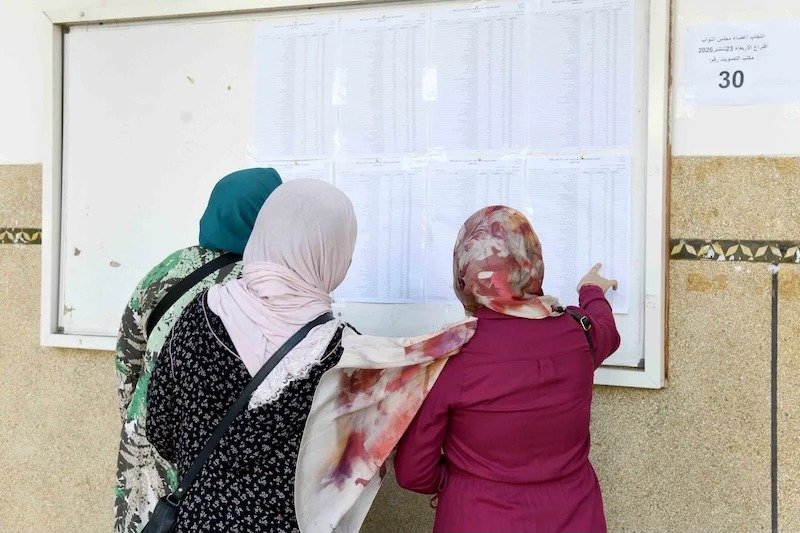
The first surprise of the 23 September 2026 legislative elections may not be the party that came first. It lies in the figures left behind after the votes were counted and the provisional results announced: the electorate itself was considerably smaller than the Moroccan society whose choices the election is supposed to reflect.
The Interior Ministry announced a national turnout of 38.08%, compared with 50.86% in 2021 and 42.27% in 2016. That means roughly six million voters took part in the election. At the same time, the number of people registered on the electoral rolls stood at 15,801,162.
The arithmetic is straightforward: nearly 9.8 million registered voters did not go to the polls.
That does not mean that all of them reject elections, political parties or politics. Non-participation can have many causes, while not being registered in the first place is different from being registered and then choosing not to vote. But the size of the gap makes it difficult to treat the results as a complete picture of Moroccan society’s political preferences.
The figure becomes more revealing when placed beside the country’s population.
According to the latest official census, Morocco had 36,828,330 inhabitants in 2024, including more than 36.68 million Moroccan citizens. The number of registered voters cannot, of course, be directly compared with the total population: the latter includes children, people who do not meet electoral requirements and other categories that are not necessarily represented on the electoral rolls. Yet the gap between the size of Moroccan society and the size of the registered electorate remains an important part of the story.
Then comes another figure.
Before the election, the authorities published the age structure of the electorate. People aged 60 and over account for more than 29% of registered voters. Those aged 35–44 represent 21%, while the 45–54 group accounts for roughly the same share. Voters aged 25–34 represent 15%, whereas young people aged 18–24 account for only 4% of registered voters.
These figures do not allow us to say that 96% of young people failed to vote. The data concern registration, not actual participation on election day. But they reveal an issue that predates polling day itself: young Moroccans aged 18 to 24 are far more present in Moroccan society than they are on the electoral rolls.
The issue takes on another dimension when placed alongside the labour market.
According to Morocco’s High Commission for Planning, the second-quarter 2026 labour-market figures, produced under the new methodology of the national employment survey, put the labour force at 11.764 million and the national activity rate at 42.2%. Among people aged 15–24, the activity rate was only 22.9%. The HCP itself has warned that the new figures are not directly comparable with older series because of methodological changes.
The challenge Morocco is carrying into the next five years therefore cannot be reduced to forming a government or distributing ministerial portfolios. There is an entire generation whose relationship with political institutions cannot be measured solely by whether it chooses one party or another. It also depends on whether politics is still seen as a practical route toward employment, better education, healthcare, housing and improved living standards.
The Associated Press, in its coverage of the electoral period, interviewed young Moroccans with different views and found employment, income, education and healthcare among the concerns repeatedly raised. The agency also noted that people aged 18–24 account for roughly 12% of the population, while representing only 4% of registered voters.
Yet the election did not produce a political vacuum.
At parliamentary level, the Authenticity and Modernity Party (PAM) came first with 97 seats in the provisional results, followed by the National Rally of Independents (RNI) with 66 and the Istiqlal Party with 65. The Justice and Development Party won 54 seats, the Popular Movement 29, the Socialist Union of Popular Forces 26, the Party of Progress and Socialism 19 and the Constitutional Union 17, with the remaining seats going to other parties.
The first three parties alone hold 228 of the 395 seats. An absolute majority in the House of Representatives requires 198 seats.
But having the arithmetic for a majority is one thing. Making a political decision to form a coalition is another. Numbers can show what is possible; they cannot establish what political parties will decide.
There is also a constitutional dimension that cannot be left out of the next stage. Article 47 of the Constitution provides that the King appoints the Head of Government from the political party that comes first in elections to the House of Representatives, based on the results. Article 88 then provides for the government to seek the confidence of the House on the basis of its programme, by an absolute majority of its members.
The PAM’s first-place finish is therefore not simply a position in an electoral ranking. If the provisional results are confirmed, it places the party in a specific constitutional position. The shape of the government, the number of parties that will participate in it and the distribution of responsibilities remain political questions that cannot be settled by adding up seats alone.
The election also shows that no single party comes close to holding a majority on its own. The leading party has only 97 seats, far below the 198 required. The next government will therefore necessarily depend on agreements among several political forces if it is to secure parliamentary confidence.
This matters because Morocco is entering this new phase under economic and social conditions different from those of 2021.
The state is pushing major investments and infrastructure projects ahead of the 2030 deadlines. In July 2026, the National Investment Commission approved 29 projects worth nearly 42 billion dirhams, with around 9,800 jobs expected, including 2,400 direct and 7,400 indirect positions. Other strategic projects were also approved in electric vehicles, aerospace and textiles.
But everyday concerns do not disappear because investment figures are large.
The Morocco preparing for 2030 will need to turn major projects into visible employment opportunities, while ensuring that their economic effects reach people and regions that do not necessarily experience national growth indicators as an improvement in their daily lives. The Morocco 2030 Foundation has itself been presented as a mechanism to coordinate and monitor major projects linked to international deadlines, while connecting them to economic and social development and youth integration.
The next five years can therefore be measured through indicators far less spectacular than electoral speeches and party programmes: the number of jobs actually created, households’ ability to absorb prices, the quality of schools and hospitals, access to housing, regional inequalities, and whether major investments generate a wider economic cycle beyond the cities and areas that host the projects.
The election provides another indication. Twenty-eight political parties and two lists of independent candidates competed for 395 seats, with 1,850 lists and more than 7,288 candidacies. Women accounted for 2,658 of those candidacies.
The issue, therefore, is not a lack of political supply in quantitative terms. The parties were present, the lists were numerous and the seats were contested. The distance appears somewhere else: in the number of citizens who actually entered the electoral process.
Still, 38.08% should not be turned into a sweeping judgment on the election itself. The Interior Ministry said the vote took place under normal conditions nationwide, with isolated incidents that, according to the ministry, did not affect the overall conduct of the process. Participation also varied considerably from one region to another. Authorities reported particularly high turnout in the southern provinces, including 77% in Laâyoune-Sakia El Hamra, 53.48% in Guelmim-Oued Noun and 61% in Dakhla-Oued Eddahab.
The national picture is therefore not uniform.
The national figure, however, remains: 38.08%, compared with 50.86% five years earlier.
Between those two figures lies a political and social distance that changing the order of the parties cannot, by itself, close.
The next government will emerge from an elected Parliament and, once the constitutional investiture process is completed, will have the constitutional mechanisms required to exercise its responsibilities. But the level of participation raises another question as well: how can the citizen who went to the polls feel that their vote has become part of a collective decision, and how can the political system reach the citizen who never registered, the citizen who registered but did not vote, or the citizen who no longer sees elections as a necessary route toward improving everyday life?
The provisional results will not answer that question, nor will the distribution of the 395 parliamentary seats.
The answer will begin to emerge when parliamentary numbers become public policies, and when the effects of those policies begin to be measured in citizens’ lives. That is when the distance between the Parliament born on 23 September 2026 and the Morocco it is expected to represent can actually be observed.


