

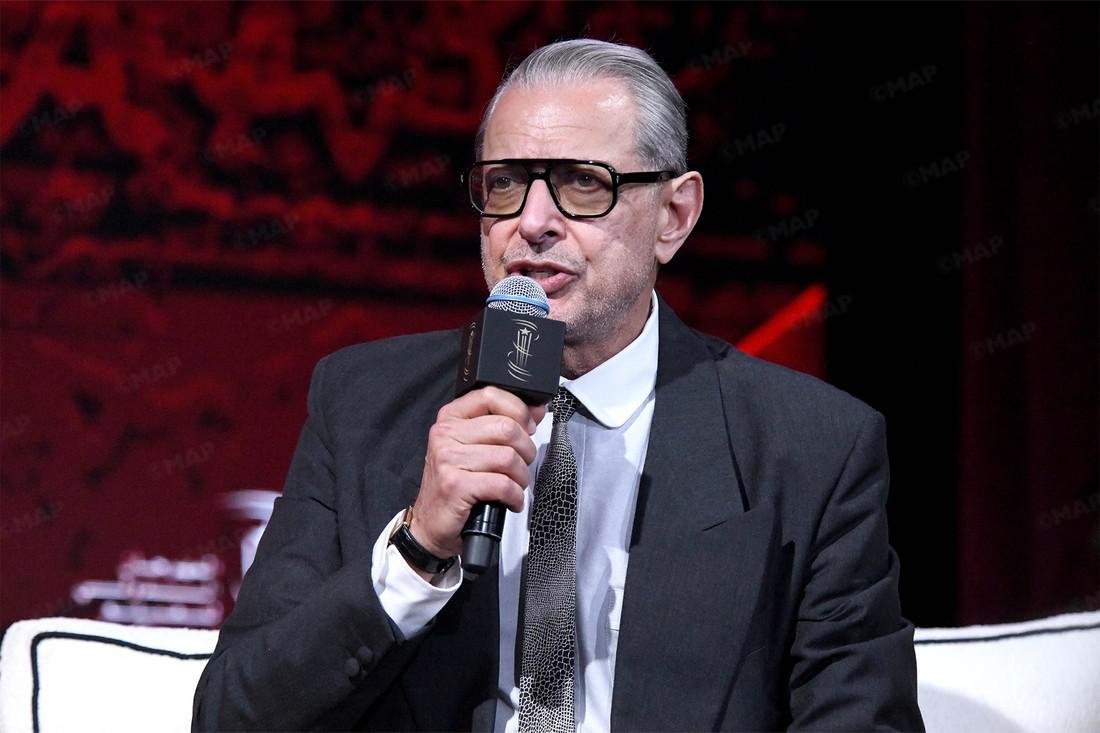
From character development to the philosophy of creative work, the American actor reflects on the craft of acting and the details that shape a screen persona.
Marrakech – The presence of American actor and musician Jeff Goldblum brought a distinctive Hollywood dimension to the 23rd edition of the Marrakech International Film Festival. Beyond celebrating a film career spanning nearly six decades, his encounter with the audience offered an opportunity to explore his approach to acting, the relationship between an actor and a character, and the collective work that takes place long before a film reaches the screen.
The meeting was part of the festival’s “Conversations” programme, which brings prominent figures from international cinema before audiences to discuss their professional journeys, artistic choices and understanding of filmmaking. Goldblum took part in the programme on November 25, during a festival running from November 20 to 28, 2026.
Widely recognised for his performances in Jurassic Park, The Fly and Independence Day, Goldblum represents an artistic career that extends well beyond the Hollywood productions and memorable characters with which audiences associate him. His work spans mainstream cinema, independent filmmaking, music and teaching. In Marrakech, his conversation therefore became an opportunity to examine acting from the inside, drawing on a professional journey shaped by collaborations, encounters and continuous experimentation.
From Pittsburgh to New York: The Making of an Actor
Goldblum began by recalling his childhood in Pittsburgh, where taking part in a theatrical performance at a summer camp first awakened his interest in acting. That early experience offered him a space for personal expression and encouraged him to see theatre as a means of developing an identity of his own.
His move to New York in 1970 marked a decisive stage in his development. There, he studied under renowned acting teacher Sanford Meisner, whose approach placed particular emphasis on listening, spontaneity and genuine interaction between performers.
The training helped shape Goldblum’s understanding of acting, particularly the importance of responding to others and remaining attentive to what happens within a scene, rather than simply delivering lines. These principles continued to inform his work, including his performances in major international productions.
During the conversation, moderated by film critic David Calhoun, Goldblum discussed what has enabled him to sustain a career approaching six decades. He highlighted curiosity, a continuing desire to learn, openness to new experiences, and the opportunities and encounters that can shape an artistic journey.
He described his relationship with the profession through an unusual expression: “hard work at play.” The phrase captures his belief that acting requires both professional discipline and the enjoyment of the creative process. Preparation matters, but so does the ability to remain open to discovery, experimentation and unexpected developments.
Music provides another dimension to this philosophy. A pianist and leader of the jazz group Jeff Goldblum & The Mildred Snitzer Orchestra, he has maintained a parallel musical career alongside his film work. The improvisation, listening and interaction required in jazz also find a natural extension in his approach to acting.
A Character Takes Shape Before the Camera Rolls
One of the most engaging aspects of Goldblum’s conversation concerned the actor’s contribution to a character’s physical appearance. For him, clothing, shoes, glasses and gestures are not merely decorative accessories. They are elements that help the performer discover and construct the character.
He recalled his collaboration with Steven Spielberg on Jurassic Park, when he brought his own jacket to help shape the appearance of mathematician Ian Malcolm.
He also discussed working with Wes Anderson on The Grand Budapest Hotel, recalling how he visited vintage shops in Los Angeles in search of old-fashioned glasses that would fit the director’s visual conception of the film.
These examples reveal an approach to acting that goes beyond interpreting dialogue. A particular garment, a pair of glasses or a specific way of standing can influence how a character is perceived and help the actor understand the personality being portrayed.
Such involvement requires close collaboration with the director. The filmmaker establishes the overall structure and visual language of the work, while the actor contributes an understanding of the character and proposes details that can enrich the performance. Individual initiative becomes meaningful when it serves the broader artistic vision.
This attention to detail is particularly relevant to Wes Anderson’s filmmaking, which is widely recognised for its carefully constructed visual compositions, colours, costumes and accessories. In his films, these elements become integral parts of the cinematic language.
The Work Audiences Never See
The conversation also turned to the filmmaking process behind the camera. Goldblum referred to Paul Thomas Anderson’s Phantom Thread, starring Daniel Day-Lewis, as an example of a film whose finished form depends on extensive preparation, artistic decisions and collective effort.
What audiences eventually see is the result of a process that begins long before filming and continues through post-production. Screenwriting, production design, sets, costumes, lighting, performances, music and editing all contribute to the final work.
Goldblum expressed reservations about productions that attempt to create an impression of depth without the genuine artistic construction needed to support it. The accumulation of visual effects or stylistic gestures, by itself, cannot give a film coherence.
His observation carries particular relevance in an industry where technological developments increasingly make spectacular images possible. Yet a film’s artistic value remains closely connected to the strength of its storytelling, the development of its characters and the consistency of the creative decisions that shape the whole production.
Teaching as Another Way of Learning
Goldblum also spoke about his experience teaching acting, an activity he has pursued for approximately twenty years alongside his artistic career.
He explained this commitment through his continuing desire to learn and his interest in sharing experience. Teaching allows him to revisit the foundations of acting, examine his own methods from new perspectives and deepen his understanding of the profession.
This commitment reflects his belief that acting requires continuous renewal. Teaching is not simply about passing established rules on to younger generations. It also creates an exchange in which questions, experiences and different approaches can enrich the understanding of the craft.
Music and cinema meet within this broader philosophy. Goldblum sees both disciplines as ways of telling stories and communicating emotions, even though they use different forms of expression. His role in Wicked, in which he plays the Wizard of Oz, offered an opportunity to bring together his experience as an actor and his musical interests.
Honouring a Career Beyond Hollywood
The Marrakech Film Festival paid tribute to Jeff Goldblum on Saturday, November 21, during a ceremony at which he received the Golden Star from British actress Tilda Swinton. She reflected on their artistic connection, particularly their collaboration in Wes Anderson’s The Grand Budapest Hotel. The ceremony also featured a musical performance by Goldblum on the piano.
The tribute formed part of the 23rd edition’s programme of honours, which also recognised American actor John Turturro and Moroccan artist Younes Megri.
Goldblum’s subsequent appearance in the “Conversations” programme extended that recognition beyond the celebration of his best-known screen performances. It gave the audience an opportunity to hear his thoughts on filmmaking, collective creativity, teaching and the importance of maintaining curiosity throughout an artistic career.
Between the cinema that brought him international recognition, the music he continues to perform and the teaching to which he has devoted part of his professional life, Goldblum presented in Marrakech the portrait of an artist whose relationship with his craft remains open, driven by learning and the continuing search for new forms of expression.


