

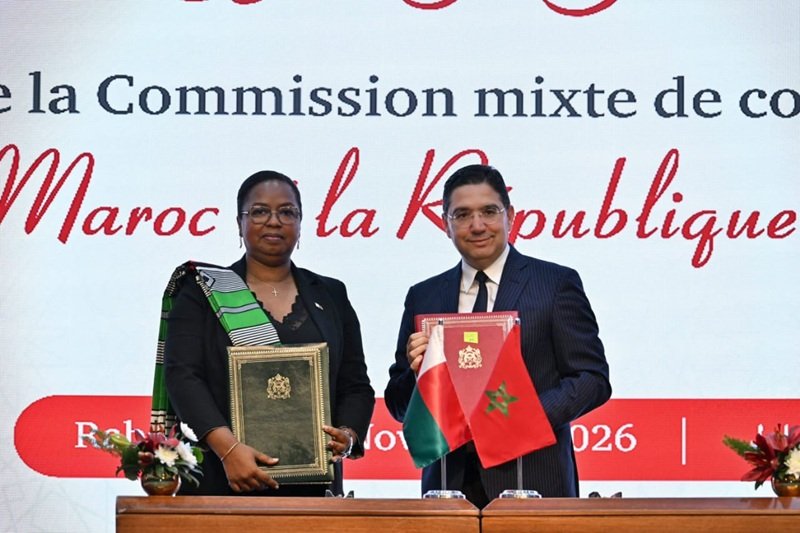
Nasser Bourita signals Morocco’s readiness to support Madagascar’s institutional transition and its return to the African Union. Increasing scholarships from 90 to 200 places puts skills development at the heart of bilateral cooperation.
The Republic of Madagascar has reaffirmed its support for the sovereignty and territorial integrity of the Kingdom of Morocco, renewing its backing for the Moroccan Autonomy Initiative as a basis for achieving a political solution to the regional dispute over the Moroccan Sahara. The position was expressed during the second session of the Morocco-Madagascar Joint Cooperation Commission, held in Rabat on Monday, 23 November 2026, co-chaired by Morocco’s Minister of Foreign Affairs, African Cooperation and Moroccan Expatriates, Nasser Bourita, and his Malagasy counterpart, Alice N’Diaye.
The diplomatic reaffirmation coincided with the signing of nine cooperation agreements and Morocco’s decision to increase the number of scholarships allocated to Malagasy students and trainees from 90 to 200, beginning with the next academic year. The discussions also included Morocco’s announcement that it was ready to support Madagascar’s efforts to restore stability and rebuild state institutions, as well as its efforts to resume participation in the activities and bodies of the African Union.
These developments bring together three interconnected dimensions of Moroccan foreign policy: consolidating positions relating to territorial integrity, expanding economic and development cooperation, and strengthening relations with African countries through support for their institutional needs. Madagascar’s situation gives this partnership additional significance, particularly in light of the political transition the country has been experiencing since October 2025.
From diplomatic positions to cooperation agreements
In the joint communiqué issued following the Commission’s proceedings, Madagascar reaffirmed its commitment to respecting the sovereignty and territorial integrity of the Kingdom of Morocco, renewed its support for the Moroccan Autonomy Initiative and welcomed United Nations Security Council Resolution 2797.
This position forms part of a broader diplomatic effort by Morocco to expand its engagement across Africa by combining clear political positions with cooperation that has economic and institutional dimensions. The significance of Madagascar’s position lies in the fact that it was expressed within the framework of a joint governmental commission and accompanied by agreements and cooperation programmes, rather than being an isolated political statement.
The rapprochement builds on earlier foundations, particularly the Royal Visit of His Majesty King Mohammed VI to Madagascar in 2016. That visit marked an important stage in the development of bilateral relations and opened opportunities for cooperation in sustainable development, training, healthcare and human development. The opening of Madagascar’s embassy in Rabat in November 2024 further strengthened direct diplomatic relations between the two countries.
The nine agreements signed during the current session cover several areas, including mutual administrative assistance in customs matters, trade and industrial cooperation, youth affairs, scholarships, training, the exchange of expertise, vocational education, equipment, agriculture, tourism, handicrafts and the social and solidarity economy.
The discussions also addressed the possibility of expanding cooperation into additional sectors, including maritime fisheries, energy, mining, electricity, energy efficiency, water resource management, meteorology, seawater desalination and wastewater reuse, alongside infrastructure, transport, digital transformation and artificial intelligence.
These areas reflect the potential complementarity between the two countries. Madagascar, an island state with significant agricultural, maritime and mineral resources, faces challenges related to infrastructure development, improving essential services and strengthening productive capacity. Morocco, meanwhile, has accumulated experience in agriculture, maritime fisheries, vocational training, water management and renewable energy. These capabilities could provide a practical foundation for cooperation, provided that the agreements are translated into operational programmes supported by clear implementation mechanisms.
200 scholarships: investing in skills and human capital
The decision to increase the number of scholarships from 90 to 200 represents more than an expansion in the number of educational opportunities available to Malagasy students. It reflects an effort to broaden academic and vocational training, strengthen the capacities of trainers and supervisory staff, and adapt training programmes to Madagascar’s economic and social development priorities.
The importance of this approach lies in the relationship it can establish between education and actual labour-market needs. Academic cooperation becomes more effective when it focuses on specialisations required by the national economy and enables beneficiaries to acquire skills that can be applied in their professional sectors and institutions after completing their training.
For Morocco, the initiative also provides an opportunity to deepen African relations through long-term professional and human connections. It moves cooperation beyond official meetings and diplomatic exchanges, creating links between universities, training institutions, public bodies and economic stakeholders.
The actual impact of the decision will, however, depend on the specialisations selected, the eligibility and allocation procedures, the support provided to students and trainees, and the extent to which the programmes correspond to the needs identified by the Malagasy authorities. The announcement of 200 places represents a declared policy decision. Assessing its results will require monitoring actual implementation, the number of beneficiaries and the professional outcomes of those who complete the programmes.
Madagascar’s return to the African Union: the institutional dimension of Morocco’s support
Morocco’s announced support carries an additional political dimension in light of the transformations Madagascar has undergone since October 2025. The military takeover, following a political crisis and popular protests that led to the departure of former President Andry Rajoelina, opened a new institutional phase for the country.
On 15 October 2025, the African Union Peace and Security Council decided to suspend Madagascar’s participation in all the activities, organs and institutions of the organisation until constitutional order was restored. The Council called for a swift and full return to constitutional order through a civilian transition and the organisation of free, fair, credible and transparent elections. It also stressed the need for an inclusive national dialogue.
The Malagasy crisis therefore concerns the legitimacy of institutions and the conditions governing the political transition. It also places the country’s external relations before a central challenge: restoring confidence and addressing its regional and international commitments.
Nasser Bourita announced Morocco’s readiness to support Madagascar’s efforts to strengthen stability and rebuild state institutions, as well as to back the roadmap presented by the Malagasy authorities for returning to an institutional framework, including constitutional reforms and the organisation of elections. He also expressed the Kingdom’s willingness to support Madagascar’s return to participation in the African Union and its institutions, while emphasising respect for the will of the Malagasy people and the choices of their authorities, without interference in the country’s internal affairs.
Understanding this position requires a distinction between the bilateral support announced by Morocco and the institutional powers of the African Union. Rabat can provide political and diplomatic support, share experience and contribute to institutional capacity-building. The lifting of Madagascar’s suspension, however, remains subject to the African Union’s decision-making process and the authority of its competent bodies, as well as to progress towards the restoration of constitutional order.
The Malagasy roadmap will also depend on its ability to generate national consensus around reforms and electoral arrangements. The African Union and the United Nations are following this process. During a meeting with Malagasy President Michael Randrianirina in September 2026, African Union Commission Chairperson Mahmoud Ali Youssouf reaffirmed the organisation’s commitment to supporting Madagascar’s return to constitutional order.
Subsequent international initiatives indicate that the transition still requires sustained political and institutional work. Following a joint mission to Madagascar in November 2026, the United Nations and the African Union announced that they would continue supporting political consultations and reforms related to the constitutional process and the elections expected in 2027.
Morocco’s support therefore forms part of broader regional and international efforts to accompany Madagascar’s transition. It creates additional room for bilateral cooperation while maintaining the necessary distinction between Morocco’s diplomatic assistance and the institutional decisions that fall within the African Union’s remit.
Security Council Resolution 2797: a reference framework for Madagascar’s position
Madagascar’s renewed support for the Moroccan Autonomy Initiative comes after the United Nations Security Council adopted Resolution 2797 on 31 October 2025. The resolution represents an important development in the UN framework for the political process concerning the Moroccan Sahara.
The text supports negotiations on the basis of the Moroccan autonomy proposal and calls on the parties to engage in discussions without preconditions. It recognises that genuine autonomy could represent one of the most feasible outcomes, while reaffirming the need for a just, lasting and mutually acceptable political solution in accordance with the United Nations Charter. The resolution also extended the mandate of the United Nations Mission for the Referendum in Western Sahara (MINURSO) until 31 October 2026.
For Morocco, this development reinforces the place of the Autonomy Initiative within the negotiations supported by the Security Council. Madagascar’s renewed endorsement at this stage of the diplomatic process adds to the African support for the Moroccan proposal.
The significance of this position becomes clearer when considered alongside the nature of the partnership being developed. Morocco’s relations with African countries, when built around projects in education, vocational training, industry, agriculture, energy and infrastructure, create the foundations for sustained cooperation and give diplomatic positions a practical framework that extends beyond the moment in which they are announced.
The next phase will depend on the ability of the nine agreements to generate operational projects, the consistency of monitoring and evaluation mechanisms, and the tangible results of training and investment programmes in Madagascar. The country’s return to the African Union will remain dependent on institutional developments and the decisions of the competent continental bodies.
The second session of the Joint Cooperation Commission, held in Rabat on 23 November 2026, thus opens a new phase in Moroccan-Malagasy relations. The question of Morocco’s territorial integrity intersects with shared development interests, while Moroccan diplomacy gains an additional opportunity to strengthen the Kingdom’s presence in East Africa and the Indian Ocean region.


