

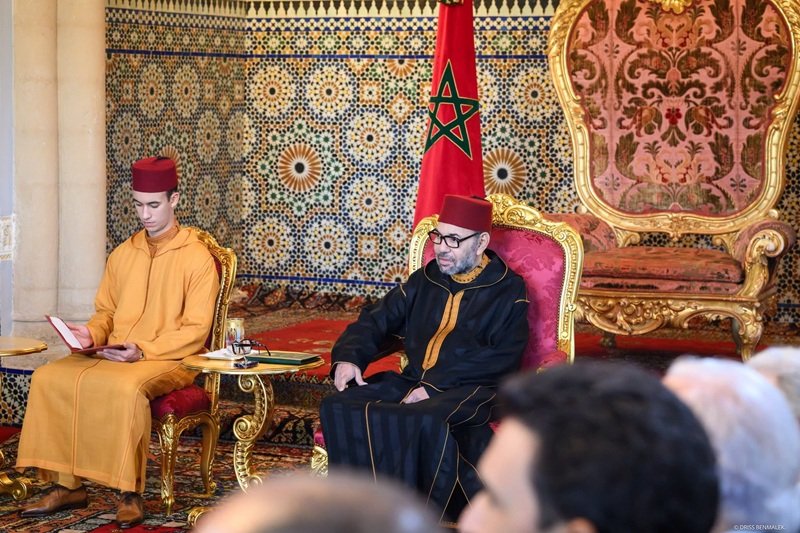
Morocco’s national defence and security manufacturing programme has entered a new institutional and financial phase. King Mohammed VI chaired a ceremony on Wednesday at the Royal Palace in Rabat to oversee the signing of two framework agreements covering the financing of the sector’s development roadmap and the mobilisation of the national private and financial sectors to implement it. Crown Prince Moulay El Hassan attended the ceremony alongside senior government, military and financial officials.
🇲🇦ترأس صاحب الجلالة الملك محمد السادس،حفل توقيع اتفاقيتين إطار تتعلقان بتفعيل خارطة الطريق لتطوير صناعة الدفاع والأمن،وتعبئة القطاعين الخاص والمالي الوطني للمساهمة في هذا الورش الاستراتيجي
خطوة جديدة نحو تعزيز السيادة الصناعية والتكنولوجية وترسيخ قدراته في مجال الدفاع والأمن pic.twitter.com/OAGXnYWByD
— Diplomatique.ma الدبلوماسية (@diplomatique_ma) November 25, 2026
The significance of this decision extends beyond establishing factories to manufacture military equipment or attracting specialised international companies. Morocco is moving towards building an industrial and technological ecosystem connected to defence and security, bringing together public financing, private investment, scientific research, military and security procurement, and exports.
The stated ambition is to transform part of the country’s defence requirements into a domestic production base capable, over time, of developing its own products and expanding into international markets.
The figures presented during the ceremony deserve close examination. They indicate the scale of the ambition while placing concrete implementation responsibilities on the institutions that signed the agreements.
From a roadmap to an industrial ecosystem with an institutional structure
The two agreements signed on 25 November gain significance when viewed alongside the working session chaired by King Mohammed VI on 18 November 2026, which focused on presenting Morocco’s roadmap for developing its defence and security manufacturing offer.
The Royal Directives emphasised accelerating implementation, establishing governance structures, defining financing mechanisms, simplifying investment procedures and mobilising private-sector participation. A contribution of MAD 4 billion from the Hassan II Fund for Economic and Social Development was also announced for this strategic project.
The two agreements signed today mark a transition from defining objectives to distributing institutional responsibilities.
The first agreement brings together the ministries responsible for the Interior, Economy and Finance, Industry and National Defence Administration, alongside the Moroccan Agency for Investment and Export Development, the Caisse de Dépôt et de Gestion, the Hassan II Fund and Mohammed VI Polytechnic University.
The second agreement extends the framework to the financial sector and business organisations, involving Bank Al-Maghrib, the Professional Grouping of Moroccan Banks, the General Confederation of Moroccan Enterprises, the Moroccan Capital Market Authority, the Casablanca Stock Exchange and the Moroccan Association of Capital Investors.
This institutional arrangement matters because defence manufacturing requires long-term financing, the ability to absorb investment risks, companies capable of meeting demanding technical and security standards, and a market that can provide relatively stable industrial demand.
Bringing banks, capital markets and investment funds into the process indicates that the State intends to move beyond financing isolated initiatives and build an ecosystem capable of attracting capital and directing it towards productive projects.
However, signing an agreement to mobilise the financial sector does not automatically mean that funding is immediately available to every company. The information released during the ceremony does not yet detail eligibility conditions, the nature of guarantees, the respective contributions of the State and private investors, disbursement schedules or how risks will be distributed among the institutions.
These details will determine whether the second agreement can translate investor interest into factories, laboratories and actual manufacturing contracts.
MAD 22 billion: What exactly does this financial envelope represent?
Ali Seddiki, Director General of the Moroccan Agency for Investment and Export Development, announced that public-sector mobilisation for the project had reached approximately MAD 22 billion.
The figure deserves particular attention. Announcing a financial envelope of this scale for the defence sector is not necessarily equivalent to announcing a fully allocated budget for constructing facilities or purchasing equipment.
A distinction must be made between funds actually available, financial commitments, investments that will be implemented in practice and private financing that may enter the programme at a later stage.
The MAD 4 billion contribution from the Hassan II Fund, announced during the 18 November working session, should be considered within the overall financial framework without being counted a second time in the total envelope unless the precise relationship between the two figures is clarified.
Financial transparency will require more detailed information on the composition of the MAD 22 billion, its sources, its intended uses and the programmes it is expected to support. It will also be necessary to establish whether the envelope covers industrial infrastructure, research and development, training and workforce development, or primarily investment-support mechanisms.
This is not merely an accounting matter. Moroccan companies, particularly small and medium-sized enterprises, need to understand the conditions for entering defence supply chains, the technical and security requirements, the cost of industrial certification and the guarantees financial institutions can provide for projects that may take several years to become commercially viable.
Law 10.20 establishes the legal conditions for entering the sector
The project is supported by a legal framework that predates the current roadmap.
Law No. 10.20 concerning defence and security equipment, weapons and ammunition was promulgated under Dahir No. 1.20.70 of 25 July 2020 and published in Official Gazette No. 6904 on 30 July of the same year. It was followed by Decree No. 2.21.405 of 15 July 2021.
The law defines categories of defence and security equipment and subjects their manufacture, import and export to an authorisation regime. It also establishes conditions for companies authorised to operate in this field, including incorporation under Moroccan law and a requirement for Moroccan majority ownership, subject to possible administrative exemptions based on defence, security, public-policy or economic-policy considerations.
The regulatory framework also provides for specifications covering safety, security, product traceability, access control and storage. Exports are subject to specific authorisations and may be accompanied by guarantees concerning the final destination of the products and restrictions on re-exportation.
These provisions become particularly important as Morocco seeks to attract foreign investors. The challenge is to benefit from international expertise and technology while preserving national oversight of sensitive activities and protecting strategic interests.
The central issue is how to structure partnerships that deliver genuine technology transfer and lasting industrial localisation. The presence of a factory on Moroccan territory does not, by itself, establish technological autonomy if production remains entirely dependent on imported components and core technologies.
Defence industrial zones and international partnerships: Where does local manufacturing begin?
The government has already adopted Decree No. 2.23.925 of 20 June 2024, establishing two defence industrial acceleration zones on land belonging to the Agency for Housing and Military Equipment.
The authorised activities include the manufacture of defence and security equipment, weapons systems, ammunition and related industrial services.
The roadmap presented on 18 November 2026 adds a major defence industrial zone in Ben Guerir and another in Benslimane, alongside the two existing zones. It also envisages the development of an integrated production chain covering design, manufacturing, maintenance, testing and storage.
This expansion could draw on the experience Morocco has accumulated in the automotive, aerospace and electronics industries. These sectors have helped develop companies, suppliers, technical skills and production infrastructure that could provide an initial foundation for manufacturing defence components and systems.
Some existing projects already illustrate the nature of this transition.
In a report published on 20 November 2026, Euronews highlighted cooperation between India’s Tata Advanced Systems and Morocco to manufacture WhAP 8×8 armoured vehicles in Berrechid, with a gradual increase in locally sourced components envisaged. The report also referred to Moroccan company MMI, which is involved in manufacturing military turrets and remotely operated weapon systems.
These projects provide examples of defence-related industrial activity taking place in Morocco. They are not, however, sufficient on their own to establish the level of technological independence already achieved.
Local assembly, manufacturing selected components, designing an entire system, developing its software and possessing the capacity to maintain and upgrade it represent different levels of industrial capability.
The higher the share of local added value, the broader the network of Moroccan suppliers and the stronger the country’s design, testing and research capabilities, the more deeply investment becomes embedded in the national economy.
By contrast, prolonged dependence on imported sensitive components and core technologies limits the industrial benefits that the roadmap seeks to generate.
40% of the needs of the Armed Forces and security services: A target requiring a clear measurement standard
The roadmap sets a target of meeting approximately 40% of the equipment needs of the Royal Armed Forces and security services through domestic production by 2035.
The objective is linked to reducing dependence on imports and establishing national capacity to meet part of the country’s military and security requirements.
However, the 40% target needs a clearly defined methodology if it is to be evaluated meaningfully over time.
Will it be calculated according to the financial value of purchases, the number of items produced or the categories of products and systems manufactured locally? Will equipment assembled in Morocco using imported components be counted in the same way as products that achieve a defined level of domestic added value?
The choice of measurement criteria could substantially change the meaning of the announced result.
Locally manufacturing communications equipment, electronic components or surveillance systems represents industrial progress. It is not equivalent, however, to possessing the ability to design and manufacture an entire defence system.
Likewise, having local spare-parts production and maintenance capabilities provides a strategic advantage even when the original equipment has been imported.
The target must also be linked to public procurement planning. The Armed Forces and security services are expected to be major customers for the new industry. Domestic demand can provide factories with an initial market and help them gradually reach competitive production levels.
The effectiveness of this mechanism will depend on companies’ ability to meet technical specifications, delivery schedules and quality standards, as well as the existence of clear procurement and contracting rules.
MAD 50 billion in annual revenue and more than 65% from exports: An ambition beyond the domestic market
The objectives presented by Ali Seddiki include generating at least MAD 50 billion in annual revenue, with more than 65% expected to come from exports.
This indicates that Morocco’s defence manufacturing industry is being conceived from the outset as an internationally oriented sector, rather than an industry intended solely to serve domestic requirements.
The choice reflects the limitations of the national market when compared with the scale of investment being envisaged. Specialised factories require sustained orders, stable production chains and external markets capable of absorbing their products. These conditions allow the costs of research, development and equipment to be spread across economically viable production volumes.
However, exports in defence and security are subject to considerations that differ from those governing conventional industrial trade.
Products must meet technical requirements, contractual reliability standards and conditions relating to end users. They are also subject to export licences and applicable international commitments.
Morocco’s Law 10.20 explicitly subjects exports of such equipment to administrative authorisation and allows the imposition of guarantees concerning final destination and restrictions on re-exportation.
Access to foreign markets will also require industrial and technological partnerships, as well as agreements enabling Moroccan products to become integrated into international value chains.
The target of generating more than 65% of revenue from exports remains an announced projection, rather than an established result. The information published so far does not provide a list of confirmed export contracts, targeted markets or products that have already secured foreign purchase orders.
50,000 jobs: Who will benefit from the new industry?
The roadmap targets the creation of at least 50,000 direct and indirect jobs by 2035.
The anticipated opportunities cover manufacturing, engineering, electronics, software development, maintenance, testing, logistics, research and development.
The economic value of this target, however, will depend on the quality of the jobs as much as on their number.
Manufacturing drones, autonomous systems, land and maritime systems, defence electronics, cybersecurity solutions and artificial intelligence applications requires engineers, technicians, software developers and specialists in industrial testing, embedded systems and advanced materials.
It also requires a skilled workforce in precision manufacturing, maintenance and quality control.
The Royal communiqué issued on 18 November placed specialised training and research at the heart of the project. It announced the development of an academy dedicated to advanced training in partnership with industrial stakeholders, while also envisaging the mobilisation of Moroccan civilian and military expertise and Moroccan professionals living abroad.
This direction has direct implications for universities, vocational training institutions and engineering schools. They will need to develop specialised programmes that respond to the technical requirements of a sophisticated industrial sector.
Involving Moroccan professionals abroad also creates an opportunity to benefit from scientific and engineering expertise accumulated in advanced technological environments. This will require practical mechanisms for knowledge transfer, the involvement of researchers in clearly identified projects and an environment that supports innovation and manufacturing.
The 50,000 jobs remain a projection for 2035. Their assessment will require annual indicators showing the number of positions actually created, qualification levels, wages, the share of Moroccan professionals and the proportion of jobs linked to research and development compared with assembly and production activities.
The DIFAA agency and the responsibility for monitoring commitments
One of the decisions announced during the 25 November ceremony was the naming of the strategic agency responsible for supporting the project: the Moroccan Agency for Defence and Security Industry – DIFAA.
According to Ali Seddiki’s presentation, the agency will monitor the commitments of the various public and private stakeholders.
Its responsibilities will include implementing the State’s strategy, promoting investment, managing support mechanisms, structuring the national industrial base and mobilising industrial compensation mechanisms, public procurement, land, skills and innovation.
These responsibilities place the agency at the centre of relations between the State, investors, manufacturers and financial institutions.
Its mission will require effective coordination between several government departments, particularly the National Defence Administration, the ministries responsible for the Interior, Economy and Finance, and Industry, as well as the institutions responsible for investment, training and scientific research.
One institutional issue deserves further attention.
The Royal communiqué of 18 November referred to a governance structure comprising a specialised strategic agency and an industrial holding company tasked with structuring the production ecosystem, mobilising public and private capital and contributing to the emergence of national industrial players.
The communiqué of 25 November, meanwhile, focused on the naming of the DIFAA agency and its operational responsibilities.
The information published during the ceremony does not yet provide sufficient details about the legal status of the industrial holding company, the stages of its establishment, its relationship with the agency or the precise distribution of responsibilities between the two structures.
Institutional clarification will be necessary so that investors understand where strategic coordination ends and where investment and industrial management responsibilities begin.
Industrial offsets and public procurement: The real test of technology transfer
The roadmap includes instruments intended to transform international investments and partnerships into industrial capabilities within Morocco. Among them are industrial compensation mechanisms, commonly known as Industrial Offsets.
Depending on the nature and conditions of the agreements, these mechanisms can link certain major procurement contracts to industrial, investment or technology-transfer commitments in the beneficiary country. They can therefore contribute to developing local suppliers and building technical expertise.
Including this instrument among the agency’s responsibilities reflects an intention to use international industrial and defence partnerships to develop domestic production capabilities.
The success of industrial offsets will need to be measured through concrete outcomes: the volume of components now manufactured locally, the number of Moroccan companies integrated into supply chains, the technologies actually transferred, the skills acquired by engineers and technicians, and the ability of Moroccan factories to continue production and maintenance after agreements with foreign partners come to an end.
Public procurement is another essential instrument for providing factories with initial demand.
This requires a clear procurement programme that enables qualified companies to invest on the basis of reasonable production expectations while respecting defence, security, quality and competition requirements.
Defence manufacturing as part of Morocco’s broader economic transformation
The project is also connected to a wider economic strategy aimed at increasing the contribution of private investment to national investment.
Ali Seddiki recalled the objective presented to the King in February 2022, which seeks to raise the share of private investment to two-thirds of total national investment by 2035.
He also referred to the Royal guidance contained in the July 2026 Throne Speech, calling for broader access to bank and non-bank financing, with priority given to small and medium-sized enterprises, innovation, manufacturing and exports.
Integrating defence and security manufacturing into this strategy creates opportunities for private investors in technologically demanding industrial activities that can draw on Morocco’s experience in automotive manufacturing, aerospace, electronics and software.
However, the participation of small and medium-sized enterprises will need to be organised from the outset.
Large projects may attract international groups and substantial capital, but a significant share of the economic impact will depend on the ability of Moroccan companies to manufacture precision components, provide technical services and participate in maintenance, testing and development activities.
This requires support, financing and qualification programmes, alongside clear and transparent conditions for accessing contracts and supply chains. The objective should be to prevent national participation from remaining concentrated among a limited number of major investors.
It will also be important to distinguish foreign investment that creates genuine production capacity in Morocco from investment that merely establishes assembly facilities dependent on imported technology and components.
The first model can contribute to building an industrial base capable of evolving over time. The second leaves a substantial share of added value outside the national economy.
What the implementation phase must demonstrate
Following the signing of the two agreements, attention now shifts towards the details that will determine how the roadmap is implemented.
The announced objectives extend to 2035, but achieving them requires measurable intermediate milestones, a clear allocation of responsibilities and a monitoring system covering financial, industrial and technological commitments.
Institutional and journalistic scrutiny will need precise answers to several questions:
-
What is the detailed composition of the MAD 22 billion envelope, and what types of financial commitments does it include?
-
How will the Hassan II Fund’s MAD 4 billion contribution be allocated, and under what conditions?
-
What mechanisms will enable banks and investment funds to finance defence manufacturing companies?
-
When will the DIFAA agency begin exercising its responsibilities, and how will it relate to the industrial holding company announced in the roadmap?
-
What programmes will connect universities, research centres and companies to manufacturing projects?
-
How will the 40% domestic coverage target and the 65% export revenue target be measured?
-
What share of industrial contracts and added value will go to Moroccan companies, and how many skilled jobs will actually be created?
These details will make it possible to distinguish the scale of announced mobilisation from the volume of investment actually implemented. They will also help differentiate the establishment of factories in Morocco from the development of an industry that possesses genuine design, development, production and maintenance capabilities.
Morocco is placing defence and security manufacturing among its major industrial and investment priorities for the period leading to 2035. The Royal Directives, legal framework, industrial acceleration zones and two framework agreements have established an institutional and financial foundation for this transformation.
The responsibility now facing the DIFAA agency and its partners is to turn that foundation into productive projects, qualified Moroccan companies, locally developed technologies and actual export markets.
The value of this experience will ultimately be measured less by the number of agreements signed or the volume of financing announced than by what emerges from Moroccan factories and laboratories, and by the expertise and production capabilities acquired by the country’s engineers, technicians and researchers.


