

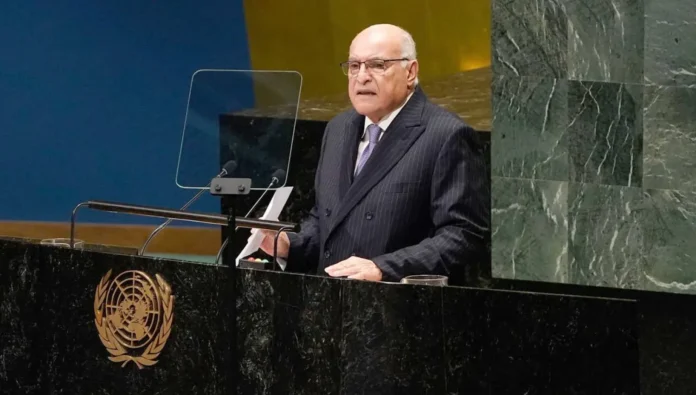
Algerian Minister of State and Minister of Foreign Affairs, National Community Abroad and African Affairs Ahmed Attaf revealed on Thursday, 26 November, that Algeria had opened discussions with the United Nations on the future of the functions previously performed by the United Nations Mission for the Referendum in Western Sahara (MINURSO). The initiative follows the expiration of the mission’s mandate on 31 October, as the United Nations begins winding down its presence under the existing institutional framework.
Speaking at a press conference at the headquarters of Algeria’s Ministry of Foreign Affairs, Attaf said the discussions with the United Nations were aimed at finding a formula that would allow some of the mission’s former functions to continue, without necessarily retaining its previous institutional structure. He stressed that consultations were still under way and that no final decision had been reached.
The statement carries implications beyond the announcement of technical discussions concerning a UN operation whose mandate has expired. Algeria, which had made the continuation of MINURSO and its referendum-related official name central to its interpretation of Security Council Resolution 2797, adopted in 2025, now faces a different situation. The mission whose continuation Algiers had defended has entered a winding-down phase, while Algerian diplomacy is seeking to preserve some of its functions within the United Nations system.
The turning point came on 30 October 2026, when the Security Council failed to adopt the US draft resolution concerning MINURSO’s future. The American text received eleven votes in favour but was blocked by Russia’s veto, while China, Pakistan and Somalia abstained.
The US draft proposed extending the mission’s mandate until 31 October 2027, while changing its name from 1 November to the United Nations Mission in the Sahara, replacing the existing designation, United Nations Mission for the Referendum in Western Sahara. It also envisaged restructuring the mission, reducing its military component and preparing proposals for its future organization. In addition, it placed Morocco’s autonomy initiative under Moroccan sovereignty at the centre of the negotiations, describing it as the most feasible solution.
These provisions help explain Russia’s objections. Moscow argued that the American proposal went beyond a routine renewal of a UN mission’s mandate and introduced political changes affecting the framework for a settlement and the conduct of negotiations, potentially prejudging the outcome of discussions between the parties.
However, Russia’s veto did not secure the continuation of MINURSO under the arrangement defended by Algeria and the Polisario Front. Following the rejection of the American text, Russia submitted an alternative draft calling for a one-year extension until 31 October 2027, while retaining the mission’s previous name and mandate.
The Russian proposal received only three votes in favour, from Russia, China and Somalia. The United States voted against it, while the remaining eleven Council members abstained.
Both drafts therefore failed: the American proposal was blocked by Russia’s veto, while the Russian alternative did not obtain the minimum number of votes required for adoption. MINURSO’s mandate consequently expired at midnight on 31 October 2026, triggering the process of winding down the mission in accordance with the arrangements governing the end of its authorization.
This sequence calls for a more precise reading of the diplomatic outcome. Russia’s veto prevented the adoption of an American proposal that included substantial changes to the mission’s name and operational framework. Yet it did not provide the legal basis required to extend MINURSO’s mandate. The direct outcome of the failure of both initiatives was therefore the expiration of the mission’s mandate, rather than a victory for the arrangement defended by Algiers.
From presenting MINURSO’s extension as a Polisario gain to seeking its functions after the mandate expires
Ahmed Attaf’s statements on 18 November 2025 provide a useful reference point for measuring the shift in Algeria’s diplomatic position.
Following the adoption of Resolution 2797, the Algerian foreign minister described the one-year extension of MINURSO’s mandate as one of the main gains achieved by the Polisario Front. He argued that the decision preserved several elements central to Algeria’s interpretation of the settlement process: the continuation of the mission under its referendum-related name, the continued role of the United Nations, and the rejection of an approach that would limit negotiations exclusively to Morocco’s autonomy initiative, leaving the final outcome to agreement between the parties.
At the time, Attaf outlined three main elements of what he considered these gains, placing the continuation of MINURSO first and emphasizing the continued involvement of the United Nations in the issue.
One year later, the nature of the Algerian minister’s statements has changed. The question facing Algiers is no longer how to extend MINURSO’s mandate, but how to preserve some of its functions after the authorization of the mission has expired.
The difference is both institutional and political. A mandate extension allows an existing mission to continue operating under a Security Council resolution, with a defined leadership, structure, resources and responsibilities. Preserving selected functions through other UN arrangements, by contrast, would require a different institutional framework, whose nature and powers would depend on decisions taken by the United Nations and its competent bodies.
Attaf has not announced an agreement with the Organization, a draft resolution or an operational mechanism that has received approval. He has confirmed only that consultations are taking place and have not yet produced a final decision.
It would therefore be premature to speak of a new MINURSO or of the mission continuing under another name. What is established at this stage is that its mandate has expired, the winding-down process has begun, and discussions are continuing over some of the functions it previously performed.
Washington and Moscow: A dispute over the nature of the next phase
Security Council documents show that the disagreement leading to the rejection of both draft resolutions concerned more than the mission’s name or the duration of its mandate. It also involved the political framework intended to guide the next phase.
The US draft resolution, S/2026/868, linked MINURSO’s future to a review of its functions and to developments in the direct negotiations held in Washington and Madrid involving Morocco, the Polisario Front, Algeria and Mauritania. It placed Morocco’s autonomy initiative under Moroccan sovereignty at the centre of the negotiations and described it as the most feasible solution.
The draft also requested that the United Nations High Commissioner for Refugees complete the registration of refugee populations in the Tindouf area within six months, in accordance with international law and UNHCR standards, with the necessary guarantees for access and freedom of movement.
The Russian draft, S/2026/870, proposed extending MINURSO’s mandate until 31 October 2027 without adopting the American changes to the mission’s name or functions.
This divergence indicates that Moscow was not simply defending the continuation of the mission. Russia was also seeking to preserve the framework through which the issue had traditionally been managed under existing UN references, in contrast with the American approach, which sought to reorganize the UN mechanism in light of political developments and ongoing negotiations.
The voting results reflected this disagreement. The American proposal obtained broad support, while the Russian draft failed to secure the minimum number of votes required for adoption.
The end of the mission does not mean the disappearance of the issue from the United Nations
In his statements on 26 November, Ahmed Attaf also challenged interpretations suggesting that the expiration of MINURSO’s mandate would remove the Sahara issue from the United Nations framework. He recalled that the question continued to be addressed by the General Assembly, the Fourth Committee on Special Political and Decolonization Matters, and the Special Committee of 24.
This distinction is important. MINURSO is an operational mechanism established by the Security Council under Resolution 690 of 1991. The question of the Sahara, meanwhile, continues to be considered by other UN bodies, each operating within its own mandate and procedures.
The expiration of MINURSO’s mandate therefore does not remove the Security Council’s authority to consider the issue, nor does it prevent the matter from being placed on the Council’s agenda again in accordance with its rules. Attaf himself noted that any UN member state could request the inclusion of the issue on the Council’s agenda.
However, the end of the mission changes the nature of the United Nations’ operational presence on the ground. It raises practical questions concerning ceasefire monitoring, field reporting, communication with the parties and the logistical capacities previously provided by MINURSO.
UN Secretary-General António Guterres has emphasized that the end of MINURSO’s mandate does not mean the United Nations is abandoning its responsibility to support a political solution. He has also reiterated the continuing role of his Personal Envoy, Staffan de Mistura, in this process.
The UN political process can therefore continue through the Personal Envoy and diplomatic mechanisms, even in the absence of the mission in its previous field structure.
Morocco’s approach extends beyond the dispute over the mission’s name and mandate
For Morocco, the new phase involves continuing to consolidate its autonomy initiative as a political basis for negotiations, while strengthening international support for the proposal within the framework of the Kingdom’s sovereignty and territorial integrity.
The latest American draft demonstrated that Washington had gone beyond a routine mandate renewal when it described autonomy under Moroccan sovereignty as the most feasible solution and placed it at the centre of the next negotiating phase.
The proposal also included operational provisions concerning the restructuring of the mission and the registration of refugees in the Tindouf camps. These matters extend beyond the traditional debate over MINURSO’s name and its historical referendum-related function.
At the same time, the Fourth Committee and the Special Committee of 24 remain UN forums in which the issue continues to be addressed. Moroccan diplomacy will therefore need to maintain its engagement within these bodies, broaden international support for the autonomy initiative and take account of the specific responsibilities of each institution.
An important procedural distinction must also be made: the UN General Assembly does not operate under a veto system comparable to that of the Security Council. General Assembly decisions are taken according to the voting rules set out in Article 18 of the UN Charter, depending on the nature of the question under consideration. Any Moroccan diplomatic initiative within the Fourth Committee or the General Assembly must therefore rely on building diplomatic support and securing votes under the applicable procedures, rather than confronting a veto.
What is Algeria actually seeking to preserve?
Ahmed Attaf’s statements raise a central institutional question: which functions does Algeria want to preserve, which UN body could take responsibility for them, and what legal basis could support such an arrangement?
Ceasefire monitoring, the preparation of reports, support for the political process and mine-related activities were among the functions performed by MINURSO to varying degrees. But the possible continuation of some of these activities does not automatically mean that the mission itself will continue. Nor does it guarantee that the United Nations will reproduce its previous responsibilities under a different name.
Algeria has not yet presented a detailed proposal on this matter. It has also not disclosed the precise nature of the arrangements being discussed with the United Nations or the position of the Security Council regarding them.
The reference to February 2027 as the expected deadline for completing MINURSO’s winding-down process suggests that the coming months will be devoted to finalizing the arrangements connected with the end of the mission’s field presence. The future of the functions Algeria wishes to preserve will depend on the outcome of the consultations and on decisions taken by the competent UN bodies.
The Security Council meeting of 30 October revealed a particular diplomatic configuration: Russia succeeded in blocking the American proposal but failed to secure adoption of its own alternative. The United States, despite obtaining a broad majority in favour of its draft, did not achieve an extension of the mandate. The result was the expiration of the mission.
After presenting MINURSO’s extension in 2025 as a political gain for the Polisario Front, Algiers is now speaking about the need to preserve some of the mission’s functions after its mandate has ended. The shift between these two positions illustrates the new challenge facing Algerian diplomacy: retaining the instruments of UN presence that it had traditionally relied upon in managing the issue, at a time when international discussions are moving towards a reorganization of the political and institutional framework for negotiations.


