

Nearly seven decades after the 1955 “Lasselle Saint-Cloud” episode, relations between Morocco and France appear to be entering a deep phase of reconfiguration. Yet this is no longer the same world in which the original framework was shaped. Power dynamics have shifted, global alignments have changed, and strategic partnerships are now defined by functionality rather than historical inertia.
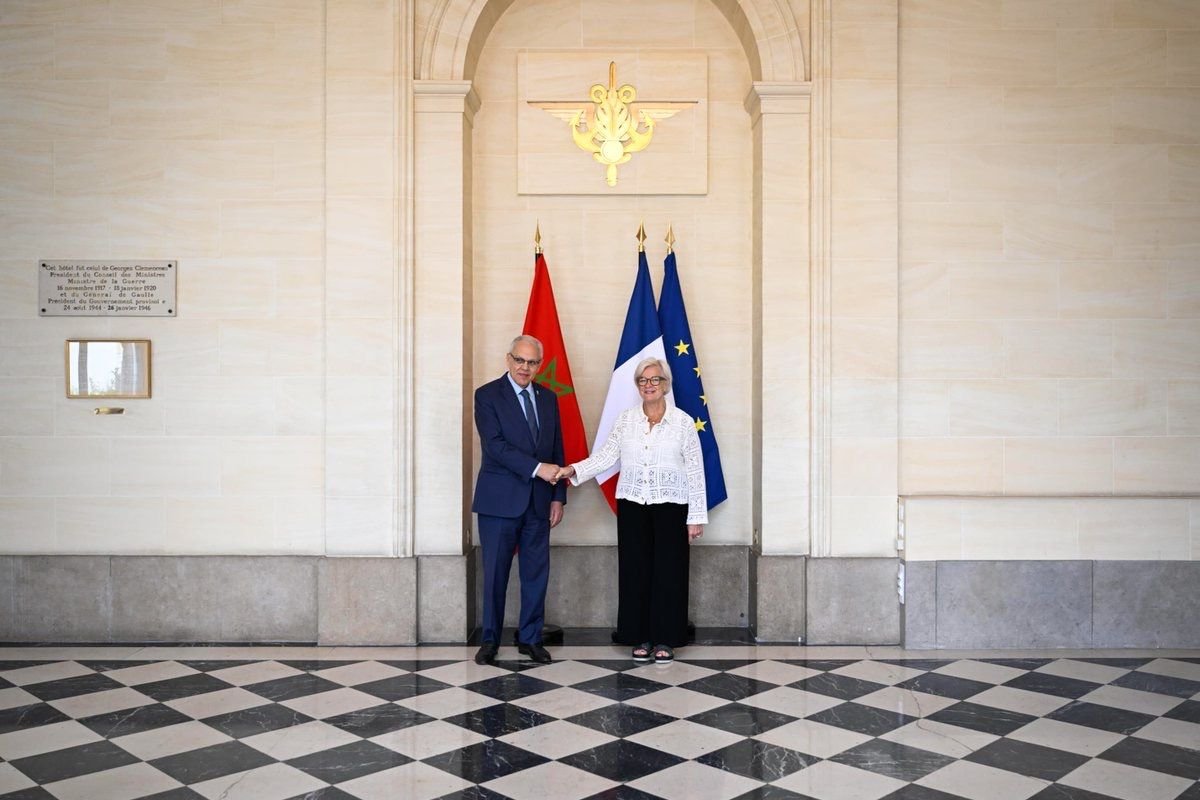
The talks held in Paris between Abdellatif Loudiyi and Catherine Vautrin, on the sidelines of the Eurosatory defence exhibition, go far beyond routine diplomatic engagement. They reflect a broader strategic recalibration between Morocco and France, where defence cooperation is becoming a core pillar of geopolitical repositioning.
Behind this evolving dialogue lies a larger political horizon: the anticipated state visit of King Mohammed VI to France. This potential milestone, coupled with the prospect of a new bilateral treaty, suggests a transition toward a fundamentally renewed framework that may go beyond the legacy of the 1955 agreements, historically rooted in a very different global context.
What stands out in the Paris discussions is not only their content, but their language. The discourse is shifting away from simple military procurement toward technology transfer, industrial co-development, capability sovereignty, and integration into defence value chains. This linguistic evolution signals a structural transformation: Morocco is no longer positioning itself as a traditional arms customer, but as an emerging regional actor seeking industrial autonomy and strategic production capacity.
In this reconfiguration, Morocco is increasingly perceived as a rising geopolitical platform linking the Atlantic, the Mediterranean, and West Africa. This geographical and strategic positioning allows it to operate as a hub where security, migration, energy, and investment intersect. Its diversified defence partnerships—spanning the United States, Turkey, Israel, and other global actors—further reinforce its negotiation power and reduce dependency on any single strategic axis.
For France, the equation is different but interconnected. The gradual erosion of its influence in parts of the Sahel and the broader restructuring of African power balances are pushing Paris to rethink its external partnerships. Within this context, Morocco emerges not only as a stable partner, but also as a strategic gateway to a rapidly evolving African continent.
Defence cooperation, therefore, cannot be separated from the broader architecture of bilateral relations. It is embedded in a wider system that includes industry, technology, training, cybersecurity, and regional stability. Military cooperation becomes a reflection of deeper transformations in the international order itself.
A key dimension of this evolution is the preparation of a new generation of bilateral agreements. Diplomatic sources suggest that a comprehensive strategic treaty may be in the making, potentially replacing older frameworks and integrating economic, security, and cultural dimensions into a unified structure. Within this future architecture, defence occupies a central role, particularly in relation to technology transfer and joint industrial projects.
The upcoming Morocco–France high commission meeting in Rabat represents an essential intermediate step. It will serve to assess progress on joint initiatives and prepare the political and technical groundwork for the royal state visit.
Ultimately, what is unfolding goes far beyond bilateral diplomacy. It reflects a broader redistribution of roles within a shifting international system: Morocco seeks to consolidate an expanded form of sovereignty and strategic autonomy, while France attempts to redefine its place in a rapidly transforming African and Mediterranean environment.
The central question remains open: is this merely an upgrade of a historic partnership, or the beginning of a deeper restructuring of power relations between two states long bound by history, yet increasingly driven today by the logic of a new geopolitical era?


