

Yet the greatest paradox of the post lies elsewhere. In its search for international actors, it almost overlooked the central actor standing at the very heart of the crisis: thousands of young Moroccans who left their towns and villages, convinced that the opposite shore—despite all its dangers—had become less unforgiving than the reality they faced every day. Before asking who might be seeking to bring down Pedro Sánchez’s government, a far more pressing question should have been raised: who brought these young people to such a profound state of despair?
The post chose to examine the crisis from above, through the prism of governments, geopolitical rivalries, and international power struggles. Yet the real tragedy was unfolding from below, in the footsteps of young men and women walking toward the sea, many of whom did not even know where their journey would ultimately end. Between these two perspectives, the essential truth is lost: mass migration does not begin at the border; it begins within society itself, at the moment when individuals lose faith in their future.
Against this backdrop, the testimonies of several young people who claimed to have received messages on their mobile phones urging them to head toward Ceuta at a specific time deserve careful consideration. If verified, such accounts would indicate that someone sought to exploit a climate of social frustration and channel it toward a particular objective. Yet these testimonies do not justify leaping directly to conclusions about who orchestrated the operation. There is a profound difference between acknowledging the existence of digital incitement or coordinated mobilization and definitively identifying those responsible for it.
This is precisely the distinction that the discourse required: separating what is established fact from what remains plausible but unproven. The credibility of a scholar or public intellectual is not measured by the number of hypotheses they advance, but by their ability to distinguish facts from probabilities and interpretations. The greater a speaker’s symbolic influence, the greater their responsibility to avoid presenting speculation as established reality.
Moreover, the emphasis on the possibility of “Zionist hands” raises another fundamental question: has every crisis affecting the Muslim world become automatically interpreted through the lens of an external actor? And even if foreign actors do exploit existing crises, who creates the internal conditions that make such exploitation possible? History teaches us that international powers rarely manufacture crises out of nothing; more often, they capitalize on vulnerabilities that already exist.
In reality, what unfolded in Ceuta exposed another kind of fragility: the fragility of the narrative itself. Within a matter of hours, the story shifted from being a social crisis inside Morocco to a European security crisis, then to an internal political battle in Spain, before finally evolving into theories of international conspiracies. With each transition, the original issue moved further into the background, until the young people themselves nearly disappeared from the narrative, reduced to mere statistics within political equations far larger than themselves.
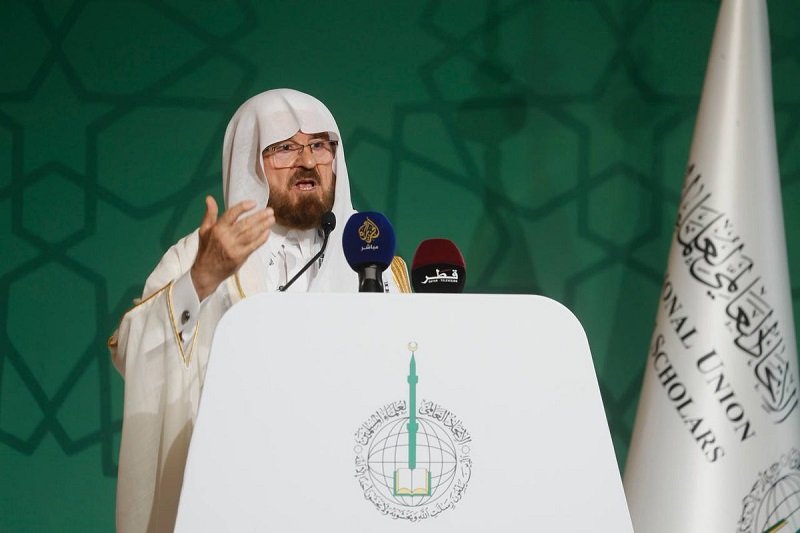
It is through this lens that Morocco’s strong reaction to Al-Qaradaghi’s post can be understood. The objection was not simply to a political analysis; it was a rejection of a discourse that drifted toward a narrative failing to begin with Ceuta’s historical reality. For Moroccans, it is impossible to describe the city as “Europe’s border” without first acknowledging that it is a Moroccan city that remains under Spanish occupation. Any reading that bypasses this historical fact—regardless of its author’s intentions—grants the opposing narrative an unnecessary strategic advantage in the battle over historical memory and public consciousness.
For that reason, the most troubling aspect of the post is not necessarily what it said, but what it chose to leave unsaid. It devoted considerable attention to the future of Pedro Sánchez’s government while barely addressing the future of the thousands of young people whose despair drove them into the unknown. It spoke of Europe’s borders, yet remained silent about the boundaries of social justice and the limits of hope that had collapsed within an entire generation. In doing so, priorities were effectively reversed: politics became more important than people, geography more important than history, and hypotheses more important than facts.
This is the fundamental distinction between a discourse that seeks to explain an event and one that seeks to redirect its meaning. The former begins with the human being; the latter begins with political calculations. The former asks, “Why did these young people choose to leave?” The latter asks, “Who stands to benefit from their departure?” Between these two questions lies the defining nature of every narrative—and, ultimately, the choice each discourse makes regarding whom it places at the center of the story.


