

Ceuta: When the Real Story Is No Longer Migration, but the Timing of It
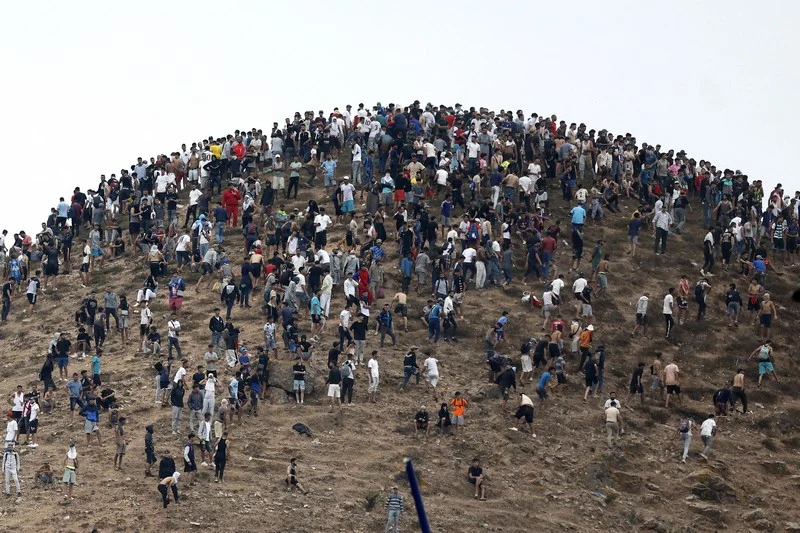
As Morocco’s public squares were filled with the colors of the Throne Day celebrations, and the nation’s attention was focused on the King’s speech reviewing the country’s achievements and outlining the priorities of the next stage, an entirely different scene was unfolding just a few kilometers away, on the outskirts of Ceuta. Thousands of young Moroccans were moving toward the Spanish border in what became one of the largest waves of attempted crossings in the enclave’s history. More striking than the contrast between these two scenes was their coincidence in time. It is therefore legitimate to ask: was this merely an unfortunate coincidence, or was the timing exploited by certain actors to generate a political or media impact that extended far beyond the migration issue itself?
That question gains further relevance when one considers the testimonies of several young people who told journalists that their decision to head toward Ceuta did not originate at the border. According to their accounts, it began on the screens of their mobile phones, after they received messages and online posts claiming that the crossing had been opened. At that moment, the story moves beyond the physical frontier and enters the digital sphere. It is no longer simply about migration; it becomes a question about the origin of information, the way it spread, and the forces that may have amplified it.
In journalism, the true value of an interview lies not only in the answers that are given, but also in the questions that remain unasked. When a reporter asked one of the young returnees, “Who told you that customs—or the crossing into Ceuta—was open?”, the answer was as simple as it was revealing: “The Spaniards… Spanish pages suddenly appeared on our phones.” For any investigative journalist, such a statement should not represent the conclusion of the story. It should mark the beginning of the investigation.
Taken on its own, this testimony does not establish the existence of a coordinated operation. It does, however, open the door to a series of legitimate questions that deserve careful examination. What exactly were these pages? Who operated them? Were they established news outlets or anonymous social media accounts? Did their content spread organically, or was it amplified through advertising tools, recommendation algorithms, or other digital distribution mechanisms capable of reaching large audiences in a very short period of time? In other words, was the circulation of these messages spontaneous, or was it deliberately amplified?
These are precisely the questions that the available facts allow journalists to ask, and they are questions that deserve thorough investigation. By contrast, describing the episode outright as a conspiracy or as an attempt to overthrow or destabilize the political system would go far beyond what the currently available evidence can support. Sound journalism requires a clear distinction between verified facts, observable indicators, and working hypotheses. Confusing one with another weakens both the investigation and its credibility.
However, if a fact-based investigation were eventually to establish that one or more actors intentionally disseminated misleading information, amplified false reports, or exploited a highly symbolic national occasion such as Throne Day to encourage thousands of young people to move toward the border, then the central question would no longer be simply who encouraged these young people to leave, but why was this particular moment chosen? Was the objective to manufacture a border crisis? To place Morocco under media pressure during one of its most significant national celebrations? Or to impose a competing narrative capable of sharing—or even overshadowing—the national and international attention devoted to the Throne Day commemorations?
Viewed from this perspective, the episode extends well beyond the migration issue itself. Population movements across the Mediterranean are unfortunately not new. What distinguishes this case is its timing, together with the testimonies indicating that digital messages reached many young people before they ever approached the border. Consequently, the real investigation may not begin at the Ceuta crossing, but within the digital information environment itself. Contemporary crises do not always originate at border fences; they often begin with a notification on a smartphone, a widely shared post, or a viral claim that, within a matter of hours, evolves into a tangible reality on the ground.
The central question, therefore, may not be why these young people went to Ceuta, but rather who created the narrative that persuaded them to go, why did that narrative emerge at that precise moment, and who ultimately benefited from its timing? Until these questions are answered through verifiable evidence rather than speculation, a crucial part of this episode will remain beyond our understanding, leaving interpretation to fill the space where investigation should lead.


