

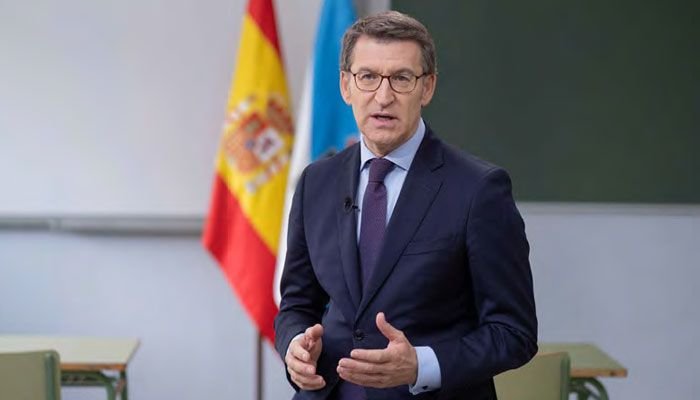
When Alberto Núñez Feijóo, leader of Spain’s People’s Party, says that Morocco will be the first country he visits if he becomes prime minister, he is doing more than naming a possible diplomatic destination. He is defining, from the outset, the place Rabat would occupy in his vision of Spain’s foreign relations. At the same time as he announces that Morocco would be his first destination abroad, Feijóo launches one of the sharpest attacks of his political discourse against Pedro Sánchez, accusing him of “behaving more like a subject of Morocco than the president of the Spanish government.” The two positions are not contradictory. The core of Feijóo’s message lies elsewhere: the problem, in his view, is not the importance of Spain’s relationship with Morocco, but the way Sánchez has managed it.
Feijóo’s choice of Morocco also carries a historical and political dimension. A visit to Rabat had long been an unwritten diplomatic tradition for several Spanish prime ministers, from Felipe González to José María Aznar, José Luis Rodríguez Zapatero and Mariano Rajoy, before Sánchez chose Paris in June 2018 for his first bilateral meeting with Emmanuel Macron. Months later, in November of the same year, Sánchez made his first official visit to Morocco, where he described relations between the two countries as a strategic partnership built around shared challenges. Feijóo is therefore not merely reviving a diplomatic protocol. He is using that symbol to deliver a political message: if the People’s Party reaches government, it would reorder Spain’s priorities from the very beginning.
Yet the political weight of the statement lies not simply in the choice of Rabat, but in the way Feijóo places that choice against Sánchez. He wants to tell Spanish voters that it is possible to maintain a close relationship with Morocco without, in his view, surrendering Spain’s negotiating position. That is why he combines the idea of a “smooth and respectful” relationship with the demand that Rabat respect Spain, presenting reciprocity as the foundation on which he would build the relationship. The debate therefore moves beyond the simple question of whether Spain should be close to Morocco. It becomes a more sensitive question: who holds the stronger position within that relationship? That is precisely the political ground Feijóo is trying to occupy.
His description of Sánchez as behaving like a “subject of Morocco” is therefore not simply a diplomatic criticism. It is a political instrument designed to redefine the domestic Spanish dispute. Feijóo cannot realistically build an electoral strategy around breaking with Rabat, because Spain’s own interests make Morocco an indispensable partner on security, migration, trade, energy and regional cooperation. He has consequently chosen a more politically usable formulation: Morocco is important, but Sánchez, in his view, has managed that importance in a way that has weakened Spain. The bilateral relationship thus becomes a domestic political issue, directly linked to the government’s image and its ability to defend national interests.
The timing gives this message an additional dimension. Feijóo made his remarks in the aftermath of the migration crisis in Ceuta, which once again placed Spain’s southern border at the centre of political debate. The pressure on the city at the end of July brought border control, migrant reception and the role of the central government back into the confrontation between the government and the opposition. Ceuta is precisely where three issues that Feijóo can connect converge: security, migration and relations with Morocco.
His emphasis on Ceuta therefore goes beyond political solidarity with Juan Vivas, the president of the city’s autonomous government, with whom Feijóo says he speaks daily. The city gives him a point where several levels of Spanish politics intersect. The question then becomes whether Madrid can maintain a genuinely strategic partnership with Rabat while simultaneously demonstrating that such a partnership does not give the other side influence over Spain’s border security. Feijóo does not offer a technical answer to that question in his statements. But he uses it to weaken the image of Sánchez as a leader capable of managing Spain’s relationship with its southern neighbour.
What is particularly revealing is that Feijóo does not take his criticism to the point of calling for a rupture. He does not propose cutting dialogue with Rabat or returning to a policy of permanent confrontation. On the contrary, he says he wants good relations with Morocco, but on the basis of trust, respect and firmness whenever Spanish interests are at stake. That distinction matters because it shows that his target is not the strategic structure of the Moroccan-Spanish relationship itself, but the political balance within it. A People’s Party government would therefore not necessarily mean abandoning cooperation with Rabat; it could instead mean attempting to redefine its conditions, its language and its political instruments.
This is one of the most revealing aspects of Feijóo’s argument: Morocco appears both as a country Spain cannot afford to ignore and as a partner with whom he wants to convince Spanish voters that Madrid can deal from a stronger position. That equation reflects the transformation of Morocco’s place in Spanish political calculations. In this discourse, Morocco is no longer simply the southern neighbour associated with migration, the Sahara and security. It has become part of the test of whether any Spanish government can protect national interests while maintaining the partnerships on which it depends.
Sánchez, meanwhile, has made his relationship with Rabat politically vulnerable to opposition attacks precisely because his government has built a broader narrative around Morocco as a strategic partner. During his first official visit to Rabat in November 2018, Sánchez described the two countries as neighbours, friends and strategic partners facing common challenges. Since then, the relationship has deepened across several areas, which means that any tension over migration or borders can quickly become a debate about the political price of that partnership.
Feijóo is now attempting to reverse that equation. He wants to preserve what no government in Madrid can realistically abandon — cooperation with Rabat — while claiming that he would manage that cooperation differently. From this perspective, his statement that “my first visit will be to Morocco” is a message addressed as much to Rabat as to Spanish voters. To Rabat, it signals that a People’s Party government would not begin with rupture, but with direct engagement. To Spanish voters, it signals that direct engagement, in his presentation, would not mean submission.
This also explains Feijóo’s insistence on two concepts that may appear contradictory in electoral politics: respect and firmness. Respect is necessary because Morocco is a partner Spain cannot bypass in managing several issues along its southern frontier. Firmness is necessary because Feijóo needs to neutralise one of the easiest arguments for the Spanish right to exploit: that any flexibility toward Rabat amounts to weakness in defending Spanish interests. The People’s Party leader is therefore seeking a position between the cooperative approach associated with Sánchez and a harder line of confrontation that could be pushed by the more nationalist right.
But the real political wager may extend far beyond Ceuta. As Spain moves toward another electoral confrontation, relations with Morocco become part of a broader dispute over the meaning of the “national interest.” Does defending Spanish interests mean preserving as much cooperation as possible with Rabat, or increasing pressure on Morocco over borders and migration? And can Madrid use its relationship with Morocco to protect its own security without giving Spanish voters the impression that it depends on another state to manage part of that security? Feijóo is attempting to present himself as the answer to the second question: extensive cooperation, but from a position of strength.
The paradox is that the crisis Feijóo is exploiting politically may simultaneously demonstrate just how much Spain needs Morocco. The greater the pressure on Ceuta, the clearer it becomes that Spain’s southern border is not exclusively a domestic matter. It is a field where security, migration, geography and foreign policy intersect. Any government in Madrid will therefore have to engage with Rabat, even at moments of maximum tension. That reality prevents Feijóo’s discourse from becoming a genuine programme of rupture and instead forces him to present himself as the leader capable of managing this interdependence differently.
This is why the most significant element of Feijóo’s remarks may not be his accusation against Sánchez, but the sequence surrounding it. Before attacking the prime minister, he says his first foreign visit would be to Morocco; after the attack, he reiterates that he wants good relations with Rabat. His entire construction therefore rests on separating “Morocco” from “Sánchez”: Morocco is an indispensable partner, while Sánchez, according to the opposition narrative, is the man who has mishandled that partnership. That distinction gives Feijóo’s argument its electoral strength, because it allows him to attack the government without presenting himself as an opponent of Morocco.
Rabat, for its part, has little reason to treat these statements as the definitive announcement of a new Spanish foreign policy. Feijóo is speaking today as opposition leader and as head of the party seeking to enter Moncloa, not as prime minister. But the significance of his remarks lies in the language they reveal in advance: if the People’s Party reaches government, Morocco could remain at the top of Spain’s diplomatic agenda while simultaneously becoming a central element of domestic political calculations. Proximity to Rabat could therefore continue, while the way Madrid uses that proximity in its internal political debate could change.
At its core, Feijóo’s battle with Sánchez over Morocco is therefore not a contest between those who want Morocco and those who do not, nor simply between openness and confrontation. It is a battle over how the relationship itself should be defined. Should it be a strategic partnership requiring a high degree of mutual trust, or a relationship of interests that must remain under constant pressure to ensure that partnership never turns into dependence? Feijóo is clearly choosing the second approach, while recognising that the first journey from Moncloa to Rabat would still be necessary if he wants to govern Spain in accordance with its real interests.
The phrase “my first visit will be to Morocco” therefore ceases to be a matter of diplomatic protocol and becomes a much more complex political declaration. Feijóo is telling Spanish voters that he will not turn his back on Rabat, but he is also telling them that he would not, in his own political framing, approach Morocco from the position of weakness he attributes to Sánchez. Between these two assertions lies a political battle that will go beyond Ceuta and migration and reach a deeper question: who can manage Spain’s relationship with Morocco without, at the same time, losing the image of a strong state in the eyes of Spanish public opinion? That is the test Feijóo is now placing before Sánchez — and perhaps before himself as well.


