

In a World Bank document, Morocco’s story of dealing with disasters appears almost complete: more than 230 risk-reduction projects, $304 million in investments, a national disaster risk management strategy, a specialized directorate, an insurance and financial protection system, risk maps, and an early-warning system for floods. The Bank goes beyond simply presenting the figures. It says Morocco has moved from responding after disasters occur toward building resilience before they strike. In its completion report, it gives the program a “highly satisfactory” rating.
On paper, it is difficult to find a more complete story. But journalism that looks beyond the numbers does not begin with the result that worked; it begins at the moment when that result is required to prove its value outside the report. This is where the Al Haouz earthquake first appears, followed by the floods in Ksar El Kebir and the Loukkos basin, shifting the question entirely: what does “resilience” actually mean when water levels rise, neighborhoods are submerged, and the state has to evacuate, shelter and assist people after the damage has already begun?
The Al Haouz earthquake was indeed a real-life test showing that part of the financial and institutional system Morocco had built existed and could be mobilized. The World Bank itself documented the mobilization of around $300 million through solidarity and financial-protection mechanisms after the earthquake, as well as the large-scale use of systems for registering victims and coordinating institutions. This is a genuine achievement that should not be denied. But Al Haouz also exposed the limits of what financial and institutional mechanisms can accomplish when confronted with an earthquake of such intensity.
The problem begins when this experience becomes general proof that Morocco is now capable of “anticipating” disasters. An early-warning system does not prevent a flood, insurance does not prevent a loss, and a risk map does not automatically mean that urban development will stop expanding into exposed areas. The World Bank itself indicates that, at the time of its assessment, the flood early-warning system was operating in only four pilot areas: Mohammedia, the Gharb region, the Ourika Valley and Guelmim Province, covering around 240,000 direct beneficiaries. Talking about a fully completed national system therefore requires more caution than the broad language of achievement might suggest.
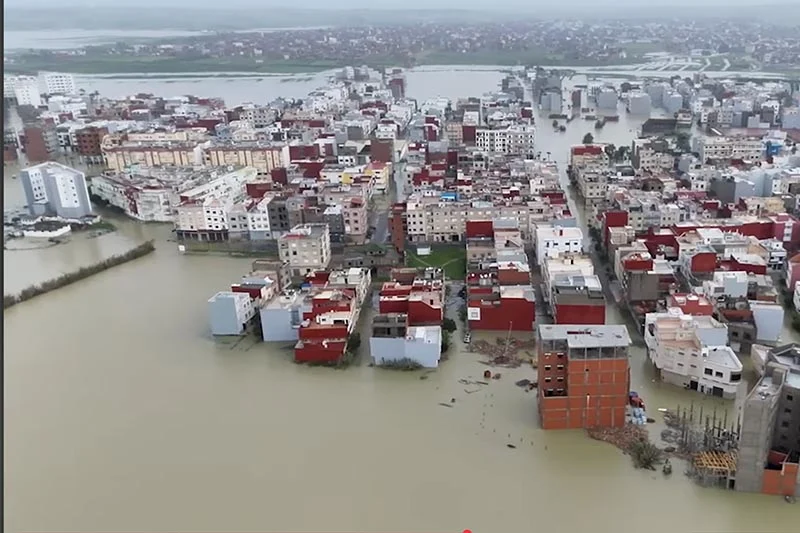
Then came Ksar El Kebir in February 2026. The Loukkos river rose, water flooded several neighborhoods, and authorities had to evacuate and shelter residents, followed by the launch of a government assistance and compensation program covering affected families, the rehabilitation of homes and businesses, and the reconstruction of destroyed houses. According to official figures, the national program addressing the effects of exceptional weather disturbances was expected to mobilize an estimated budget of three billion dirhams. There is nothing abnormal about the state intervening after a disaster; that is precisely its responsibility. The journalistic question lies elsewhere: the city was hit after years of Moroccan and international discourse about moving from managing the consequences of disasters to managing their risks.
More revealingly, the debate did not stop at the exceptional nature of the rainfall. Subsequent questions concerned projects and buildings located in exposed areas, as well as the conditions under which certain construction permits had been granted. If official investigations confirm that construction took place despite reservations relating to flood risk, then the problem goes far beyond the capacity of a drainage channel or the effectiveness of an alert. It raises a much deeper question: what does the state do when the map knows where the risk is, but urban development does not always behave according to what the map says?
This is precisely where the World Bank’s own report deserves to be reread. The document concerning the new generation of the resilience program acknowledges that previous operations helped establish “strong foundations”, particularly at the central level, but states that the new phase must move further into sectors and local authorities, strengthen urban resilience and improve the collection and sharing of risk data. In other words, the Bank itself acknowledges that the transition from the center to the ground had not been completed.
That observation changes the reading of all the figures. When the Bank says that non-structural interventions reached more than 33 million beneficiaries, it does not mean that 33 million people are now actually protected against floods or earthquakes. A significant part of that figure relates to risk awareness, planning, mapping and institutional capacity-building. Likewise, when hundreds of thousands of people benefit from risk-reduction projects, it does not mean that Moroccan cities have become impervious to disasters. The figures may be accurate within their technical definitions; what deserves scrutiny is their transformation into a broader image of a “protected Morocco.”
There is then an even more sensitive issue: the World Bank is not observing an external experience in which it played no role. It participated in financing and designing the reforms, and states that three World Bank operations, totaling around $580 million, supported institutional reforms, investments and financial-protection mechanisms. Therefore, when the Bank praises the program’s success, it is also evaluating, at least in part, the outcome of a model to which it itself contributed. That does not invalidate the assessment. But it requires journalism to maintain a distance between “the success of the program” and “the success of the state in preventing disasters.”
Morocco is therefore not necessarily selling an illusion, and the World Bank is not necessarily selling one either. But there is a danger when the language of financing and development becomes a substitute for reality on the ground. A loan or grant can finance an institution, a map can identify a dangerous zone, insurance can compensate a victim, and a report can give a program an excellent rating. None of these instruments, however, releases the state from answering the hardest questions: why were people still living in places that were flooded? And why does knowledge of risk not always translate into decisions about urban planning, construction and investment?
This is why the Al Haouz earthquake and the Ksar El Kebir floods offer two different images of the same question. Al Haouz showed that Morocco could rapidly mobilize financial resources and institutions once disaster struck. Ksar El Kebir tests something else: the state’s ability to turn knowledge of risk into decisions capable of preventing losses before they occur. Between the two lies the real distance between “managing a disaster” and “managing disaster risk.”
Perhaps the most important thing about the World Bank report is that, almost unintentionally, it opens this door itself. It says that the first generation of reforms built the foundations and that the second must reach further into cities, sectors and local territories. The story, therefore, is not over, despite what the language of achievement might suggest. What has been built is a stronger apparatus for understanding risks and financing their management. The real test now is whether that knowledge can change where we build, how we build, and what decisions are made before the water rises or the ground shakes.
This is precisely where journalism should stop counting projects and start counting what they have actually prevented. The true measure of resilience is neither the number of maps produced, nor the amount of loans mobilized, nor the number of people classified as “beneficiaries.” The real measure is how many people did not need to be evacuated, how many homes were not flooded, how many buildings did not collapse, and how much loss was prevented before it became another bill for the state and society.
That is the test no report can take on behalf of reality.


