

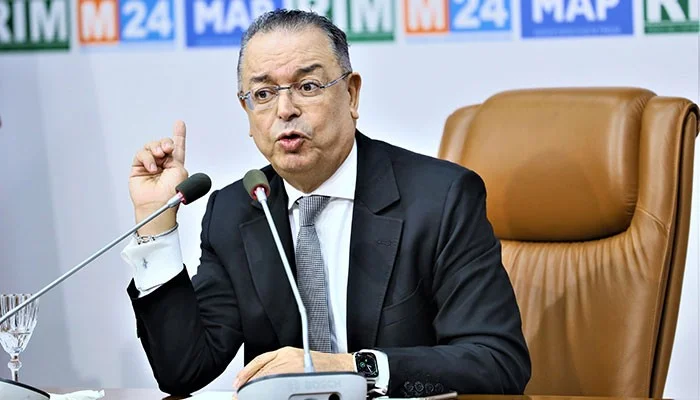
The message published by Lahcen Haddad, Vice-President of the House of Councillors and former minister, questioning the silence of intellectuals, ministers, parliamentarians, journalists, academics, business leaders and other components of the Moroccan elite when Morocco is attacked or portrayed in a distorted manner abroad, deserves to be taken seriously. Not because it reveals a new phenomenon, but because it opens a more uncomfortable question than the one he himself raises: what has this same elite done, when it held positions of responsibility and decision-making power, to build the environment that would allow these voices to exist and exert influence?
الصمت المُدوّي للنخبة المغربية…
لماذا يصمت المثقفون والوزراء والبرلمانيون والمنتخبون المحليون، ورؤساء المجالس الإقليمية والجهوية، ورؤساء اللجان البرلمانية، وكبار أطر الإدارة، والصحافيون والجامعيون والأساتذة والطلبة والمناضلون، والمحامون والأطباء، وفعاليات المجتمع المدني، ورجال… pic.twitter.com/v8op9X3fIp
— Lahcen Haddad, PhD (@Lahcenhaddad) August 15, 2026
Mr. Haddad knows, from his governmental and parliamentary experience, that the press he refers to does not emerge from tweets or from patriotic will alone. It requires an enterprise, human resources, equipment, training, translation, distribution, digital capabilities, financial stability and, above all, a project capable of lasting over time. A journalist can write an article, expose a dysfunction, deconstruct a narrative hostile to Morocco, but cannot, alone, build an international media institution from nothing. That is precisely where the real question begins—one that his message should first pose to its author before addressing it to others: how can journalists be asked to fight the battle of narratives if the institutions that would enable them to do so are not built?
This question is not theoretical for us. For several years, we have tried to present to various actors, including Mr. Haddad, the “Diplomatie Marocaine” project as a specialized media institution covering diplomacy, politics and international relations, operating in Arabic, French and English, and addressing both Moroccan readers and international audiences. We made contact, presented the project, held meetings and proposed investment or partnership because we believed that such a media platform could constitute a component of Morocco’s influence power. It did not materialize, and the project did not lead to a partnership. This experience is not mentioned here as a personal complaint, nor because any individual was obliged to finance a particular institution, but as a concrete example of the gap between a discourse calling for the existence of influential international media and the reality faced by institutions actually trying to produce that media.
The Moroccan journalist is therefore confronted with an especially harsh equation: he is expected to be present in the battle over Morocco’s image, investigate, produce, write, translate, follow events and respond to campaigns—only to face a basic question: who will finance this work? The State sets conditions for access to public support, which is understandable, since public money cannot be distributed without criteria. But if a media company must demonstrate professionalism, output, presence, regularity, human resources and other requirements, why should actual production, continuity, specialization, multilingualism and the ability to reach audiences beyond Morocco not also become explicit criteria when evaluating media institutions that are expected to contribute to the Kingdom’s international influence?
Digital technology has precisely made such an evaluation much easier. A committee can now examine a media company’s website, go through its archives, establish how long it has been operating, measure its output, identify its authors and observe the subjects it covers. It can also assess its international reach, publication languages, quality and regularity, specialization and impact. Why, then, not move from a system in which the press is considered primarily through administrative files to one that evaluates the actual media and strategic value produced by each institution?
We are not speaking here of a single institution. “Maroc Maintenant,” Diplomatie magazine, and the various media and cultural projects we have developed in several languages were born from a conviction: Morocco needs a press that does not wait for a crisis before speaking, but produces knowledge before the crisis. We write, translate, analyse, open dossiers and address readers in Arabic, French and English, seeking to build a Moroccan editorial heritage accessible beyond the country’s borders. This work has never been a seasonal activity tied to an event or campaign. It is a professional and national project that we have tried to carry forward with limited resources and, very often, through our own means.
When Mr. Haddad therefore argues that the Moroccan elite must leave its closed circles and enter the international battle of narratives, we would like to put a series of questions to him—not to lecture him. What have you done, Mr. Haddad, through the responsibilities you have held, to build a press capable of playing this role? What did you undertake when you were a minister? And what are you doing today as Vice-President of the House of Councillors? Have you discussed within Parliament the situation of media companies attempting to operate beyond the traditional media model? Have you questioned the government about institutions producing multilingual content and working on international affairs? Have you advocated a media policy conceived over twenty or thirty years, rather than waiting for every crisis before looking for journalists to respond to it?
This question does not concern Mr. Haddad alone. It concerns political parties that speak of patriotism without considering strategic media as an investment sector; business leaders who know how to invest in many fields but do not always perceive media as a component of Morocco’s economic and political power; and public institutions that could help build a media ecosystem capable of competing beyond the country’s borders. States that think seriously about influence do not wait for a crisis to erupt before searching for spokespeople. They build, beforehand, universities, research centres, media institutions, expert networks and multilingual platforms.
If Morocco genuinely wants to move from defending its image to building its image, it needs precisely this long-term vision. It needs a national media strategy that means neither government-controlled journalism nor instructions to journalists, nor an assault on the independence of institutions, but the construction of a strong, professional and diverse media sector capable of investing in investigative journalism, analysis, translation, training and international outreach. Such a vision could also include training programmes in international journalism, international law, economics, diplomacy, languages and digital-platform management, and even the creation of schools and specialised centres dedicated to producing content for foreign audiences.
For our part, we are asking neither for recognition nor payment for what we have undertaken. We are not saying that the State should finance us simply because we write about Morocco. We are saying something much simpler—and much deeper: if Morocco needs this kind of press, it must know how to build it, guarantee the conditions for its existence, and assess its work according to clear professional criteria. And if there are institutions that deserve support, that support should be based on production, continuity, quality, specialization, multilingualism and impact—not on relationships, loyalties or proximity to decision-making centres.
Mr. Haddad’s message can therefore become the starting point for a genuine national debate. The problem is not that Morocco lacks journalists, writers or researchers capable of speaking. The problem is that many of those who want to speak do not always have institutions that enable them to continue doing so, while the institutions attempting to build that presence are often required to prove their existence before they have even been given the means to develop it.
Before asking, then, “Why are journalists silent?”, perhaps we should ask a fairer question: “Why are we not building the institutions that enable them to be heard?”
And before calling on Morocco’s elite to enter the battle of narratives, another, more demanding question should be addressed to those responsible: where is the national strategy that will make it possible to fight this battle for twenty or thirty years, rather than reacting to each crisis only after it has erupted?
Because patriotism is not measured solely by the number of people who speak when an event occurs. It is also measured by the number of those who thought ahead of it, built institutions, developed plans and invested in people, media and knowledge so that Morocco would not be condemned, with every new crisis, to start again from zero.


