

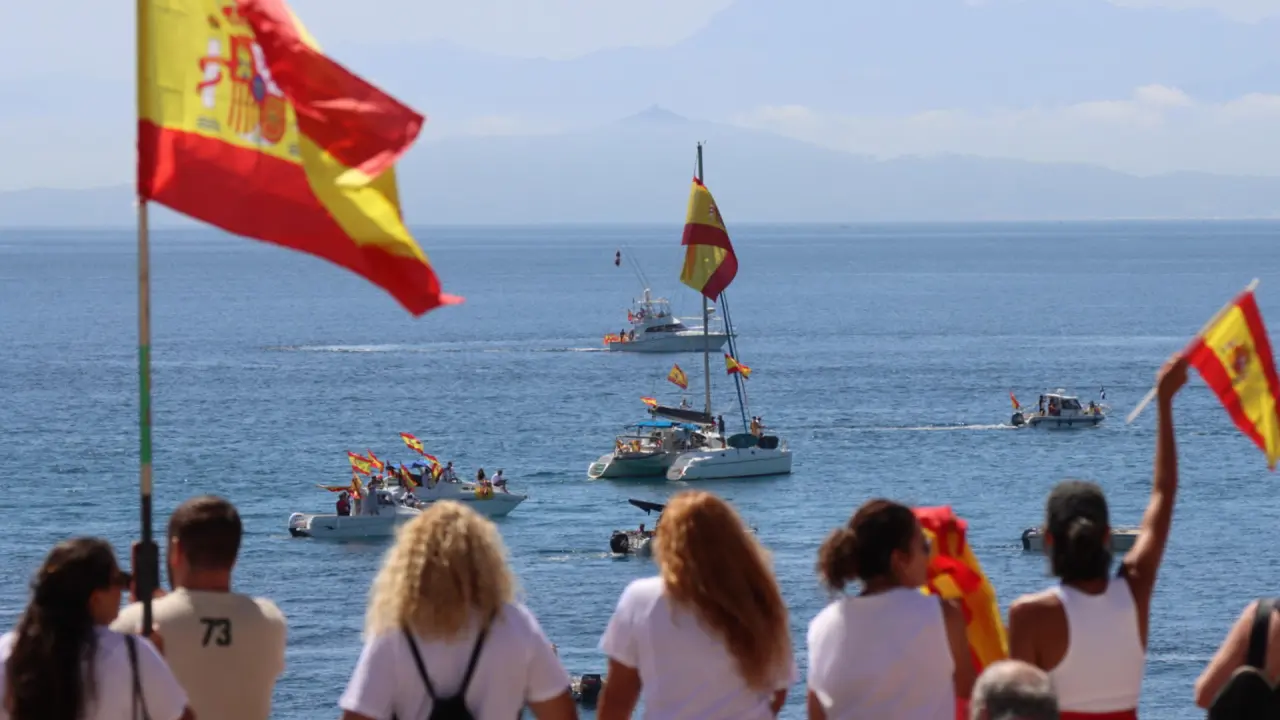
In occupied Ceuta, the migration crisis is no longer simply a management crisis for which the authorities are searching for an answer. Within a matter of weeks, it moved into the streets, then onto the beaches, and finally into the sea itself. And at the very moment when hundreds of migrants were sleeping on the ground, dozens of Spanish boats appeared off the city under the banner of a “Solidarity Flotilla.”
The image alone deserves attention.
Boats flying Spanish flags, horns sounding, slogans such as “Ceuta is not for sale, Ceuta is defended” and “Invaders, out,” while on the other side of the scene, people were still looking for somewhere to sleep, for water, food and basic sanitation.
That is where the story begins to move beyond the arrival of around 60 boats from Andalusia, later joined by local vessels, bringing the number taking part in the maritime display to nearly 100, according to Spanish media.
So what kind of solidarity did Ceuta actually need?
Was it food for migrants? Tents? Toilets and showers? Safe accommodation for children and women? Or was the real message something else: to reinforce, as the slogans and images suggested, a narrative of “siege,” “invasion” and the “defence of Spain”?
The contradiction became sharper precisely as the humanitarian crisis deteriorated.
On August 27, protesters did not limit themselves to objecting to the way immigration was being managed. Some entered areas where migrants were staying on Benítez beach, destroying makeshift shelters and setting some belongings on fire before police intervened. At the same time, protesters attempted to prevent Red Cross vehicles from reaching Tarajal beach to distribute food to migrants.
This was no longer simply a matter of verbal protest.
The Red Cross itself was blocked for more than two hours. Police eventually intervened to secure access to the distribution points. Days later, food distribution resumed under heavy police protection.
Meanwhile, living conditions exposed the harshest side of the crisis.
Human rights organisations reported that hundreds, and in some accounts thousands, of people were living in precarious conditions, including young people and minors staying on beaches and in open spaces. Human Rights Watch highlighted the lack of toilets and showers and reported that some migrants were forced to use gardens, vacant land or the sea to meet basic sanitary needs. Women and girls were also reportedly accommodated in open sports facilities, while the creation of adequate reception centres remained delayed.
And this is where the picture becomes clearer.
On one side is a city claiming that it has reached the limits of its capacity, alongside residents who say they are facing growing security, social and health pressures. That dimension of the crisis is real and cannot simply be dismissed, particularly because Ceuta is a very small city and Spanish authorities themselves have struggled to manage large arrivals.
On the other side are human beings who entered the city and then found themselves trapped between the sea, the streets and administrative procedures, some spending weeks in conditions that are difficult to reconcile with basic human dignity.
The problem begins when disagreement over migration management turns into collective punishment, and when humanitarian assistance itself becomes a target.
Then came the “Solidarity Flotilla.”
The initiative, involving boats from Andalusia, was presented as a message of support for the people of Ceuta. But the scene surrounding it was far from politically neutral. Spanish flags dominated the waterfront, while the slogans went beyond calls for the authorities to address the crisis. Some directly targeted migrants, with references to “invaders” and calls for expulsion.
The sea itself had become a political stage.
No one can reasonably ask the people of Ceuta to remain silent about their concerns. But does defending the population require turning stranded migrants into a collective enemy? And can preventing the Red Cross from reaching hungry people really be described as a form of “defending the city”?
This is not only a Moroccan issue. It is also a European one.
Europe speaks constantly about human rights, the protection of vulnerable people and respect for international law. Yet it now faces images that are difficult to ignore: migrants sleeping in streets and on beaches, a lack of basic facilities, protesters blocking food aid, followed by a large maritime display organised in the name of “solidarity.”
European funding, however, needs to be handled carefully so that the investigation does not become a slogan. Ceuta is set to receive around €26 million from the European Regional Development Fund for the 2021-2027 period. This is general development funding, not money specifically allocated to fuel the current migration crisis or reward residents for their protests. Spain has also spent tens of millions of euros on strengthening the Ceuta border since 2018.
But even when properly placed in context, the figures raise a broader question: how can Europe invest in borders, infrastructure, migration policies and security while a human being stranded on a beach remains unable to find a decent place to sleep or basic sanitary facilities?
This is where Ceuta takes us back to the heart of the problem.
It is not simply a Spanish city in North Africa, as Madrid prefers to present it in its domestic political discourse. It is also an extremely sensitive geographical point in relations between Spain and Morocco, where migration, borders, sovereignty, security and European policy intersect.
That is why the “Solidarity Flotilla” cannot be understood merely as a maritime outing by recreational boats. The timing, the slogans, the scale of the mobilisation and the messages emerging from the city turned it into a political event as much as a display presented as an act of solidarity.
The comparison with Gibraltar is more complicated than it may initially appear and should not be reduced to a single slogan. Spain continues to claim sovereignty over Gibraltar, while Madrid considers Ceuta and Melilla to be integral parts of Spanish national territory. Legally and historically, the Spanish government distinguishes between the two cases. Yet the existence of both disputes within the same geographical space inevitably brings comparison into public debate, particularly when Ceuta becomes a daily symbol of Spanish sovereignty in North Africa.
And the paradox remains: all this language about “defence” and “sovereignty” is unfolding while, on the very beaches of the city, people do not even have a tent to protect themselves from the night.
The real question therefore goes far beyond “who entered Ceuta?”
It is what happens when a humanitarian crisis becomes fuel for political identity.
At that point, the migrant ceases to be merely a person waiting for an administrative or legal decision. He or she becomes an image used to redefine fear, mobilise the streets, raise flags and unite a city around a “we” confronting a “them.”
That is the phenomenon Rabat — and Europe itself — should be watching closely.
Because the most troubling element of this scene is neither the boats that arrived in Ceuta nor the number of flags flying above the waterfront.
The most troubling element is the possibility that the human being on the beach becomes part of a political narrative; that helping him becomes a problem; and that leaving him without shelter becomes part of the management of the crisis itself.
In occupied Ceuta, the “Solidarity Flotilla” did not arrive in a city that was simply looking for help.
It arrived in a city attempting to redefine its own crisis.
And that is precisely where the story begins for Morocco to read differently: not as a passing Spanish news story, but as an illustration of how migration, at a politically charged moment, can be transformed into an instrument for manufacturing fear and mobilising identity.


