

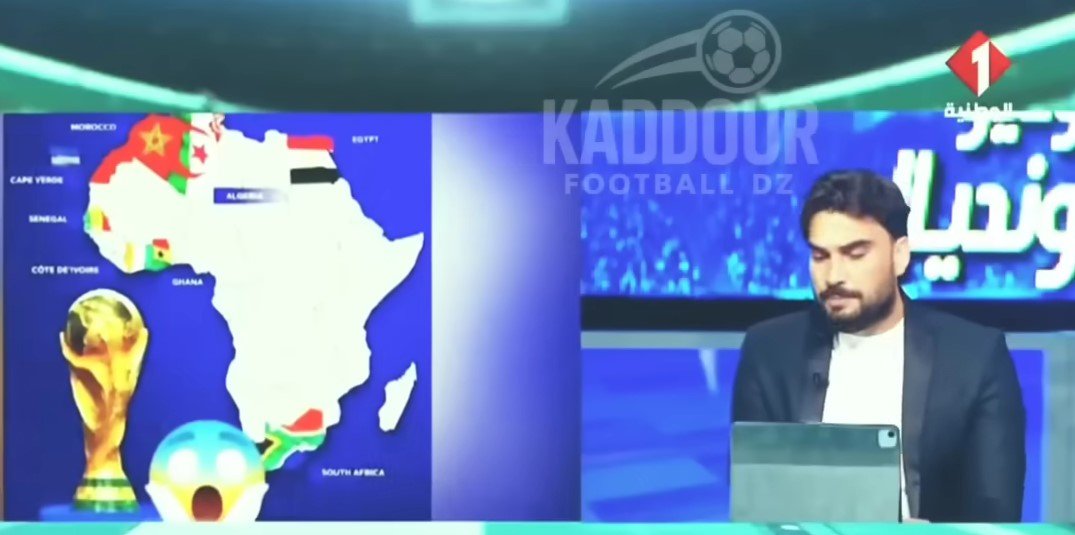
It was only a map displayed for a few seconds on the screen of a Tunisian public television channel. Yet in a region where political memory remains deeply shaped by questions of borders, sovereignty, and colonial legacies, a single geographic image can be enough to revive old controversies and reopen issues that history has never fully settled.
This is how a Tunisian state-owned broadcaster unexpectedly found itself at the center of a heated debate after airing, during a program dedicated to preparations for the 2026 FIFA World Cup, a map of Morocco that included its southern provinces while also extending into areas that some Moroccan historical narratives refer to as the Eastern Sahara, territories currently located within Algeria’s internationally recognized borders.
Within hours, the image spread across social media platforms and Algerian media outlets, transforming what appeared to be a visual illustration into a full-fledged political controversy. Reactions quickly moved beyond the explanation of a technical or editorial mistake offered by the Tunisian broadcaster, becoming part of a much broader discussion about history, collective memory, and national sensitivities.
Faced with mounting criticism, the channel issued an official statement explaining that the map had been downloaded from the internet without sufficient verification of its source or content. The broadcaster emphasized that the incident was unintentional and did not reflect any official position or editorial stance.
Yet the clarification failed to end the debate. In the Maghreb, maps are rarely viewed as neutral visual tools. They represent sovereignty, embody historical narratives, and often serve as symbols of national identity. Consequently, any territorial representation can be interpreted as a political statement, even when it results from editorial negligence rather than deliberate intent.
The reactions observed in Algeria reveal a reality that extends far beyond this particular incident. Border issues remain among the most sensitive subjects in both Moroccan and Algerian political consciousness. More than six decades after Algeria’s independence, questions inherited from the colonial period continue to shape public debates and competing interpretations of regional history.
To understand this sensitivity, one must return to the era of French colonial rule. During that period, colonial authorities repeatedly modified administrative boundaries across territories under their control. Many Moroccan historical interpretations argue that large areas of present-day western and southwestern Algeria maintained political, tribal, economic, and religious ties with Morocco before being incorporated into French Algeria through colonial administrative decisions.
By contrast, independent Algeria adopted the principle of preserving borders inherited from colonial rule, a doctrine later endorsed across Africa to prevent widespread territorial disputes after independence. Since then, the coexistence of historical claims and contemporary legal realities has remained one of the underlying sources of tension between the two neighboring states.
The 1963 Sand War remains the most visible manifestation of this disagreement. Although relatively brief from a military perspective, it left deep political and psychological scars that continue to influence public perceptions on both sides of the border. Its legacy helps explain why any reference to maps or territorial issues can still trigger strong emotional and political reactions.
The current controversy must also be understood within the broader regional context. Relations between Morocco and Algeria have experienced one of their most difficult periods in recent years, marked by diplomatic rupture, closed land borders, and the absence of meaningful political dialogue. In such an environment, symbols often carry greater weight than facts, and even a minor media incident can quickly acquire geopolitical significance.
Tunisia itself occupies a particularly sensitive position in this equation. Since President Kaïs Saïed received the leader of the Polisario Front during the 2022 TICAD summit, relations between Rabat and Tunis have deteriorated significantly. As a result, the recent incident has been interpreted by many observers through a wider diplomatic lens that extends well beyond the realm of journalism.
Beyond the political dispute, the episode raises an important professional question about contemporary media practices. In an age of digital abundance, artificial intelligence, and rapidly circulating information, verifying visual content has become just as essential as verifying written facts. Maps, like words, shape public perceptions and can influence political narratives far beyond their immediate context.
Ultimately, this controversy may reveal a deeper paradox affecting the entire Maghreb region. While many parts of the world focus on economic integration, regional cooperation, and future-oriented development, North Africa continues to find itself drawn back into unresolved debates rooted in history and memory.
The most important question, therefore, may not concern the map that appeared on a television screen. Rather, it concerns the invisible political and psychological boundaries that continue to separate neighboring nations whose geography, history, and strategic interests would seem to encourage closer cooperation. When a single image can revive decades of tension, the challenge may lie less in disputed territories than in the enduring difficulty of building trust across borders.


