

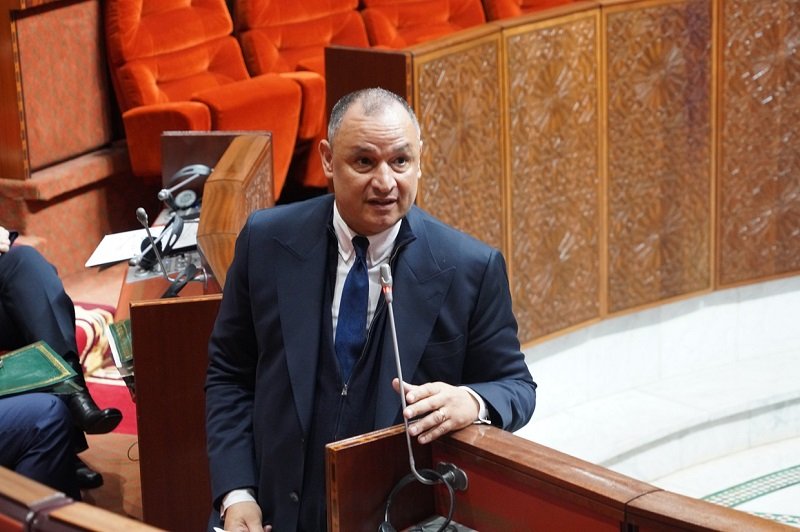
The controversy surrounding statements attributed to Morocco’s Minister of Industry and Trade Ryad Mezzour continues to generate reactions among political, civic, and community actors both inside Morocco and across the Moroccan diaspora. What initially appeared to be a short video circulating on social media has gradually evolved into a broader debate about the nature of the official discourse addressed to Moroccans living abroad and their place within national public policies concerning the country’s global community.
While some observers interpret the remarks as a personal opinion expressed during a discussion about the return of Moroccan talents from abroad, several diaspora organizations believe the issue goes far beyond a simple comment. For them, the episode raises deeper questions about how certain political elites perceive the relationship between the Moroccan state and millions of its citizens living overseas.
In this context, the organization Dar Al Maghrib in the U.S. state of New Jersey called on the minister to issue a clear and public apology to Moroccans abroad. In a press statement, the association argued that some expressions appearing in widely shared videos do not align with the level of responsibility expected from a government official, nor with Morocco’s official narrative that consistently highlights the strategic importance of its diaspora.
According to the organization, the circulating clips include expressions such as the word “bzaaṭ” and the phrase “Reste là-bas” (“stay there”), which some members of the diaspora interpret as potentially dismissive of the contributions made by Moroccans living abroad to the country’s development.
For many community leaders, the Moroccan diaspora cannot be viewed merely as an expatriate population. It represents a strategic and multidimensional asset, economically, culturally, and diplomatically, given its role in strengthening Morocco’s international presence and fostering economic connections with the homeland.
Behind the current controversy lies a deeper structural question regarding the complex relationship between Morocco and its global citizens. Today, Moroccans abroad are not only a source of financial remittances; they also constitute networks of expertise, investment, and influence across many regions of the world.
Economic indicators highlight the scale of this contribution. In 2025, remittances from Moroccans living abroad reached a record level of more than 118 billion dirhams, underscoring their critical role in supporting the country’s macroeconomic balance and sustaining the purchasing power of thousands of Moroccan families.
From this perspective, some representatives of the diaspora warn that statements perceived as diminishing their role could have symbolic and political consequences, particularly at a time when demands are growing for stronger institutional representation and deeper engagement of Moroccans abroad in national decision-making.
In response to the controversy, Minister Ryad Mezzour later clarified that his remarks had been taken out of context, explaining that his comments were directed at specific cases where he believed certain individuals exaggerated comparisons between professional opportunities in Morocco and those abroad.
Yet the intensity of the debate reveals a deeper tension surrounding the issue of reintegrating Moroccan talent from the diaspora. While official discourse encourages skilled expatriates to return and contribute to national development, practical challenges—administrative, economic, and professional—continue to complicate such ambitions.
Ultimately, what began as a controversy over a brief remark has evolved into a revealing moment in the ongoing conversation about Morocco’s relationship with its diaspora—a relationship built on pride and connection, but also shaped by growing expectations from millions of Moroccans who remain deeply tied to their homeland while living across the globe.


