

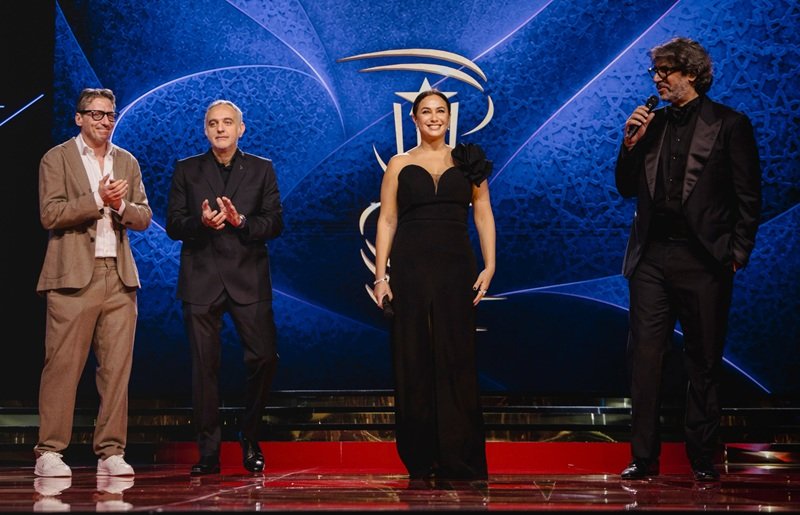
From screenwriting and directing to production, editing and character development, conversations with Luca Guadagnino and Jeff Goldblum reveal the workings of filmmaking while bringing professional experience closer to a new generation of filmmakers.
Beyond the screen: bringing filmmaking closer to new generations
The Marrakech International Film Festival offers more than film screenings and opportunities for audiences to meet the people behind the works they watch. Through its “Conversations” programme, the festival creates another space for engagement with cinema, inviting directors, actors and industry professionals to revisit their careers and discuss some of the creative and practical decisions that shape a film, from its initial conception to its final appearance on screen.
At the festival’s twenty-third edition, two conversations with Italian filmmaker Luca Guadagnino and American actor and musician Jeff Goldblum particularly illustrated this approach. Coming from different professional backgrounds, both offered insights into essential aspects of filmmaking: the relationship between screenwriting, shooting and editing, the director’s autonomy in developing projects, and the actor’s preparation and contribution to character development.
The value of these exchanges lies in their professional and educational dimension. Film students, emerging filmmakers and general audiences gain access to knowledge that is rarely visible in the finished work itself. Behind every completed film are decisions, adjustments, creative discussions and collaborations that determine its final form.
From screenplay to editing room: Luca Guadagnino explores the hidden mechanics of filmmaking
The conversation with Luca Guadagnino, held at the Meydene Theatre on Wednesday, 25 November, focused on the relationship between the written script and the images that ultimately reach the audience.
The Italian filmmaker, whose body of work includes Call Me by Your Name, Suspiria, Challengers and Queer, discussed the different stages of filmmaking and the way they interact throughout the creative process. His career, marked by a variety of visual styles and narrative approaches, gives particular weight to his reflections on artistic freedom.
The screenplay provides the foundation for a film, but it does not determine every possibility that the finished work may contain. The director’s choices, the actors’ performances, the conditions of the shoot and decisions made in the editing room all contribute to transforming the original material.
Editing occupies a decisive position in this process. The selection of a shot, its duration, its relationship with the following image and the rhythm of a sequence all influence how the audience experiences the narrative. The finished film is therefore the result of an interaction between writing, performance, direction and visual composition.
This approach also raises questions about the actor’s place in the creative process. An actor’s contribution goes beyond delivering dialogue or following instructions. Understanding a character’s motivations, contradictions and development helps shape the dramatic substance of the film.
The conversation also addressed the director’s autonomy in production. Artistic decisions are often closely connected to financing conditions, relationships with production companies and the ability to preserve a creative vision throughout the making of a film.
There is, however, an important distinction between artistic independence and financial independence. Greater freedom in decision-making does not necessarily mean escaping the economic and organisational constraints that structure the film industry.
Guadagnino also discussed his support for emerging filmmaker Giovanni Tortorici, a former assistant whom he helped bring forward by producing the film Ketticè. The experience illustrates how professional relationships can become opportunities for a younger filmmaker to move from technical assistance to leading an independent creative project.
The Italian director also spoke about his interest in Morocco, recalling previous attempts to shoot a film in the Kingdom that did not materialise, while expressing his desire to work there in the future.
This opens a broader discussion about the place of emerging talent within the industry: how can professional relationships between established directors and younger collaborators develop into genuine opportunities for production and creative leadership?
Jeff Goldblum: a film character is built through details
With Jeff Goldblum, the conversation held at the Meydene Theatre on 25 November explored another dimension of filmmaking: the actor’s craft and the process through which a character takes shape in front of the camera.
The American actor revisited his early artistic experiences, from discovering theatre through a childhood acting workshop to moving to New York in 1970, where he studied under acting teacher Sanford Meisner. That training became part of a career spanning more than five decades.
One of the principles he emphasised was the importance of finding one’s own voice rather than simply imitating others. Technical knowledge is an essential foundation, but acting also requires personal exploration and the development of an individual approach to understanding and embodying a role.
Goldblum also discussed his experience teaching acting for nearly twenty years alongside his professional career. Teaching allowed him to deepen his understanding of performance techniques while continuing to learn through his interaction with students.
He recalled his experience working on Lawrence Kasdan’s The Big Chill, which was preceded by four weeks of rehearsals. This collective preparation illustrates the importance of work undertaken before filming, particularly in productions where relationships between characters, dialogue and the development of interactions are central to the narrative.
His relationship with director David Cronenberg was also discussed through the experience of The Fly. Goldblum described the film as an important stage in his career, during which he felt he had genuine room to contribute to the construction of his character and put forward creative suggestions.
He also reflected on the different working methods adopted by directors. Some favour strict adherence to the written dialogue, as in several of his experiences associated with the Coen brothers and Wes Anderson, while others allow actors greater freedom to explore alternative approaches to performance and dialogue.
These observations underline that character development extends well beyond memorising lines and delivering them in front of a camera. It requires preparation, research and an understanding of a character’s motivations, relationships and contradictions. Voice, movement, rhythm and screen presence all become part of the process.
Different cinematic experiences, a shared commitment to passing on knowledge
The “Conversations” programme extends beyond these two encounters. The twenty-third edition featured ten meetings with personalities from different cinematic backgrounds, including Arthur Harari, Rian Johnson, Cristian Mungiu, John Turturro, James Gray, Xavier Dolan, Monica Bellucci and Moroccan filmmaker Leïla Marrakchi.
Marrakchi’s presence brings a particular dimension to the programme by giving visibility to a Moroccan filmmaking experience within an international discussion about cinema. Her work has been associated with films exploring transformations in Moroccan society, family relationships and the aspirations of younger generations.
The diversity of invited filmmakers and performers also allows audiences to encounter different approaches to storytelling, cinematography and acting, without reducing filmmaking to a single method or formula.
This initiative forms part of the Marrakech Film Festival’s broader approach, which places direct dialogue between industry professionals and audiences alongside the official competition, screenings and tributes.
For Moroccan film students and young people seeking to enter the industry, these conversations provide access to practical professional experience. Understanding how a director works with a screenplay, how an actor prepares a role or how production constraints influence artistic decisions offers a more realistic picture of the profession and its demands.
There is, however, a difference between listening to an established professional and turning that knowledge into practical skills. Conversations can open the door to learning, but they cannot replace hands-on workshops, specialised training or opportunities to work within actual film productions.
Their impact could become more substantial if they were connected to film schools, professional mentoring programmes and initiatives designed to help emerging talent gain access to the different professions within the industry.
The conversations at this twenty-third edition have therefore highlighted another dimension of the seventh art: the professional decisions, personal explorations and artistic choices that take place before a film reaches its final form.
Between a director examining his relationship with screenwriting and production, and an actor continuing to explore the possibilities of performance after decades in front of the camera, the paths towards cinematic knowledge remain varied.
The longer-term value of these encounters will also depend on their ability to foster lasting relationships between international professionals and Morocco’s emerging filmmakers, beyond the annual gathering of the Marrakech Film Festival.


