

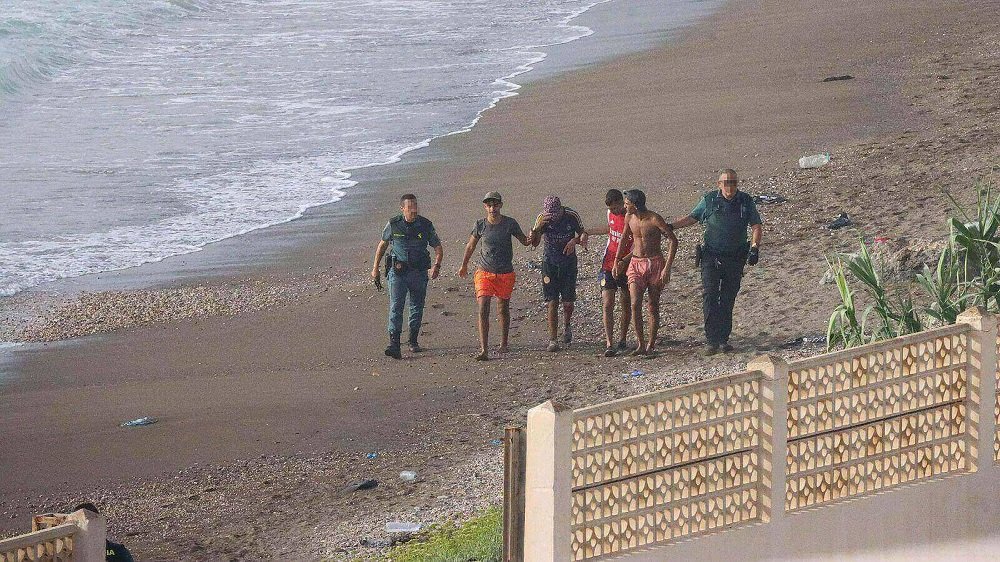
The scenes witnessed on the beaches of Fnideq at the beginning of the summer of 2026 were far more than a routine border incident or another episode of irregular migration towards Ceuta. They revealed one of the deepest paradoxes of modern Morocco. At a time when the country is investing heavily in infrastructure, expanding social protection, reforming education, developing cultural and sporting programs, and presenting itself as a rising regional power, hundreds of young people, minors, men and women were still looking across the sea as if salvation existed somewhere else.
In Fnideq, the sea was no longer merely a geographical boundary separating Morocco from Ceuta. It became a social mirror reflecting questions that run deep within Moroccan society. The minors who threw themselves into the water were not carrying political banners. They were not protesting against the government or challenging state institutions. They were simply chasing a dream called departure. That is precisely what makes the phenomenon so complex. It is not an open rebellion against the state, but a silent crisis of confidence in the future.
Over the past decade, social media has played a powerful role in shaping idealized images of life in Europe. Young Moroccans no longer compare their present circumstances to those of previous generations; they compare them daily to the lifestyles, opportunities, and expectations displayed on their screens. Economic indicators may improve, foreign investments may increase, and infrastructure projects may multiply, yet the perception of personal opportunity can still decline when individuals do not feel directly connected to these transformations.
The paradox becomes even more striking when one considers that Morocco itself has become an attractive destination. African migrants increasingly view it as a land of opportunity. Foreign investors, entrepreneurs, and European retirees are choosing Moroccan cities as places to live and work. Tangier, Rabat, Casablanca, and Marrakesh are attracting people from around the world. Yet this success raises a troubling question: how can a country capable of attracting others continue to lose some of its own people?
The answer extends far beyond economics. Migration today is no longer driven solely by poverty. Many of those seeking to leave possess education, skills, and relatively stable family backgrounds. What drives them is often not hunger but the feeling that their ambitions have a better chance of flourishing elsewhere. This is not merely a crisis of income; it is a crisis of expectations.
The situation becomes even more alarming when minors are involved. When a teenager is willing to risk drowning in the sea, the issue can no longer be reduced to border control or security management. It becomes a social, educational, psychological, and cultural question. What does it say about a society when some of its children view the dangers of the sea as less frightening than the uncertainty of their future at home?
The economic transformations experienced by Fnideq and the areas surrounding Ceuta also form part of the story. For decades, cross-border informal trade provided livelihoods for thousands of families. Its gradual disappearance opened the door to a more structured economic model. Yet the transition from one system to another inevitably creates gaps between reform and reality. It is often within those gaps that migration dreams emerge.
Politically, these scenes place the authorities before a difficult dilemma. Official reports highlight investment, modernization, and development. Yet recurring images of young people attempting to reach Europe seem to tell a different story. The two narratives are not necessarily contradictory. An economy can grow while significant segments of society continue to doubt whether they will ever truly benefit from that growth.
At a deeper level, the phenomenon challenges the very meaning of success within the collective imagination. When leaving becomes synonymous with succeeding, when migration becomes a generational aspiration, the issue moves beyond public policy. It touches the national narrative itself. Nations are not built solely through highways, ports, stadiums, and factories. They are also built through the ability to convince citizens that their future can be realized at home.
That is why what happened in Fnideq should not be viewed as just another summer migration story. It is a powerful social, political, and cultural warning. Because the most difficult challenge for any state is not always building infrastructure; sometimes it is building trust.
And the question that remains floating above the waters of Fnideq may be more significant than any economic statistic: if Morocco is increasingly capable of attracting the world, why do so many of its own young people still believe that their future lies somewhere else?


