

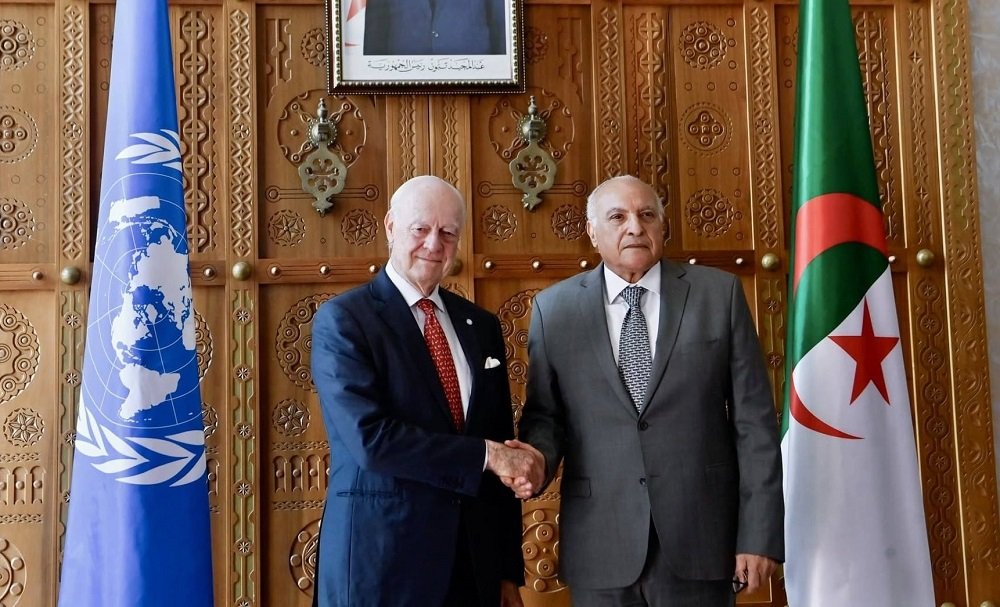
In major diplomatic disputes, meetings are significant not merely because of the statements issued afterward, but because of the political map they reveal. When an international envoy travels from Tindouf to Algiers while simultaneously intensifying consultations with Washington, he is doing more than listening to competing narratives. He is assessing the balance of power, measuring the willingness of each actor to compromise, and identifying where the momentum capable of breaking decades of deadlock truly resides.
It is through this lens that the meeting between the United Nations Secretary-General’s Personal Envoy for the Sahara, Staffan de Mistura, and Algerian Foreign Minister Ahmed Attaf should be understood. Coming after De Mistura’s visit to the Tindouf camps and amid a renewed wave of international consultations, the encounter may appear to be a routine diplomatic stop. In reality, it takes place at a moment when the international landscape surrounding the Sahara issue is undergoing significant transformation.
Over the past several years, the global discussion has gradually shifted away from the frameworks that dominated previous decades. Successive United Nations Security Council resolutions have increasingly emphasized realism, pragmatism, and the pursuit of a lasting and mutually acceptable political solution. This change is more than a matter of diplomatic language; it reflects a deeper evolution in how the international community perceives the path toward resolving the conflict.
Within this changing environment, Morocco has emerged as the actor that most effectively understood that modern conflicts are no longer addressed solely through negotiations. They are also shaped by development, institutional credibility, and the ability to create stability on the ground. Over the last two decades, Morocco has invested heavily in the Southern Provinces through major infrastructure projects, ports, renewable energy facilities, transportation networks, and public services. These developments have given tangible substance to Morocco’s vision for resolving the dispute.
As a result, Rabat has gradually succeeded in shifting the conversation from an ideological confrontation toward a debate about the future. The central issue is no longer merely the historical origins of the conflict, but rather which proposal is capable of meeting the aspirations of local populations, ensuring regional stability, and generating sustainable economic development. It is precisely within this framework that Morocco’s Autonomy Initiative has gained increasing credibility among a growing number of international partners.
Against this backdrop, Algeria faces a complex diplomatic challenge. It continues to maintain that it is not a direct party to the conflict, while simultaneously remaining an essential actor at virtually every stage of the political process. This dual position has fueled growing international debate regarding the actual responsibilities of the various stakeholders involved in the search for a solution.
The Polisario Front faces an even deeper challenge. The international environment in which the movement emerged no longer exists. Global priorities have changed dramatically. Major powers now approach regional conflicts through the lenses of security, counterterrorism, economic stability, migration management, and strategic cooperation. In such a context, initiatives capable of generating stability tend to receive greater support than scenarios that prolong uncertainty and political deadlock.
The growing coordination between the United Nations and the United States further reflects a broader desire to move the Sahara issue beyond the logic of perpetual conflict management. After decades of stagnation, many international actors increasingly appear convinced that the time has come to transform theoretical discussions into practical pathways toward resolution.
For that reason, Staffan de Mistura’s current tour goes far beyond routine diplomacy. It represents a political assessment of a conflict entering a new phase. A phase in which the essential question is no longer simply who defends which position, but which vision of the future appears most credible, most achievable, and most compatible with the realities of the twenty-first century.
Ultimately, the issue extends beyond the Sahara itself. It raises a broader question about how the modern international system deals with conflicts inherited from the past. Between the perpetuation of an endless confrontation and the gradual construction of a solution based on development, stability, and political compromise, the international community is increasingly being asked to choose not between two interpretations of history, but between two competing visions of the future.


